Q1 : What is PayPal?
PayPal is an internationally recognized e-commerce provider, with over 71 million members worldwide. Purchasing through PayPal (either with your credit card or an electronic funds transfer directly from your checking account) is fast, easy, and 100% secure. PayPal has very strict procedures to ensure complete e-commerce security; this protects both the merchant and the customer. |
link |
Q3 : Do you offer custom picture framing services?
Yes, we offer a comprehensive selection of frame styles at very competitive prices. You can view the selection on our Frames & Mouldings page. Please contact us if you require custom picture framing. |
link |
Q4 : I have an old photo that I want restored and put on canvas. Can you do that?
Yes, we do offer photo restoration services, along with canvas printing. Your photos can be mailed to our mailing address to be scanned. Please contact us for pricing. |
link |
Q5 : What must the minimum resolution of my digital picture or file be, to be printed on canvas?
There is no formula, as maximum print size for a given photo depends on many factors like source (digital camera or scanned file), sharpness, camera lens, file format, compression, photo subject and so on. For example, we have printed 2 MB, 3000x2000 pixel photos at 48"x32" frame size. If you like, you can e-mail us your photo before placing an order. We are happy to consult with you on the best print size for your photo, based on its quality/resolution. Please note: photo subject/style is also a factor to consider. For example, in abstract photos the subject is more important than the resolution and print details, so you can ask for a larger print size.
When printing on canvas, the canvas' texture minimizes pixelations, which also allows us to print a larger image. However, we will not ship an order until we are sure the print quality is acceptable. If we have any concern, we will contact you for a better quality digital file or photo replacement.
To learn more, read our article about working with low resolution images. |
link |
Q6 : What canvas print sizes do you offer?
We can print up to 64" wide on a 40' roll. If you would like your Canvas Print created in a different size then please contact us for a quotation. We use only fine art printers, inks and canvas. |
link |
Q7 : What are the copyright restrictions on printing?
You can have any image printed on canvas provided you own the copyright for the image, have written permission from the owner of the copyright, or it is in the public domain. It is up to you as the purchaser of the image to ensure you have the proper legal permissions. |
link |
Q8 : How is the canvas print protected? What finishing method do you use?
For canvas prints we use ClearShield Type C Coating as a protective finish. Type C is formulated to be used over water-resistant canvas printed with pigmented inks. While the Epson UltraChrome K3 Inks are already UV resistant, the coating has some additional UV buffers as well, and when applied to the print, the finish can further protect it from scratching, finger prints, or smudging.
Order online: Clearshield coatings |
link |
Q9 : How should I upload or send my photos if they are larger than 10 MB?
Please use our upload form if the file size in under 16 MB:
file uploads
For larger file sizes, you may send a link to your uploaded file on a web/FTP server or through free online services like http://www.yousendit.com/ or http://www.dropbox.com/
You can also use free open source FTP software such as
http://filezilla-project.org/
If you are familiar with FTP software, please contact us for our FTP server info.
INSTRUCTIONS:
- Download the Firezilla CLIENT from http://filezilla-project.org/ and install it.
- Once you have installed Firezilla, launch it.
- On the top of the application there will be 3 blank spaces where you will enter the host, password and user name provided.
- Click on the Quickconnect button.
- Once it is connected, you can drag your files to the center/right area* (in green) and drop them to the center/left area (red). *Note that the center/right area shows the files in your computer and you will have to find your files first.
- Wait until your file uploads to our server successfully.
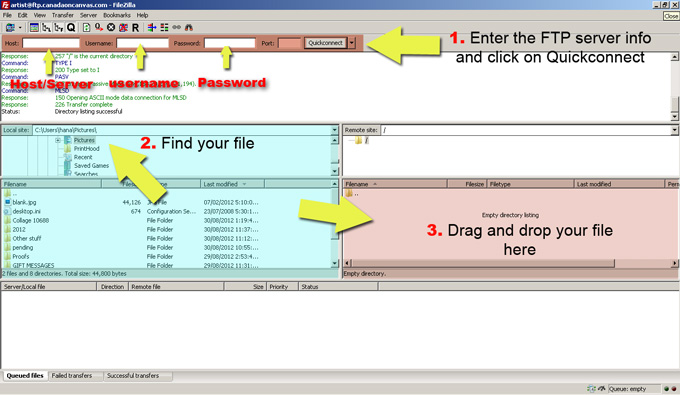 To learn more, see our article all about Sending Large Files.
 |
link |
Q10 : Is there a minimum quantity that I have to order?
No. We will take as much care with your single print of a family portrait or favourite image as we do with our larger volume orders. |
link |
Q11 : Are there any setup fees?
No. You are charged when you complete the checkout from your shopping cart, and not before. |
link |
Q12 : Can I email my image to you as an attachment?
Yes, it is possible to submit images via email. If you choose to submit an image by email, please send only JPEG file formats with a maximum size of 16 MB. |
link |
Q13 : Can I save my image on a CD or DVD and mail it to you?
Yes, this is probably the best way if it is larger than 20MB. If you are transferring your image(s) to a disc, we recommend uncompressed TIFF file format. |
link |
Q14 : Which file formats are best for canvas prints?
The suitability of the file format really depends on whether you intend to submit your image by email, FTP or by mail. As a general rule, JPEG files are best if submitting by email or uploading, while TIFF files are best if submitting by FTP or on CD or DVD.
JPEG files are lossy, meaning that when they compress image data, they throw some of it away. When a JPEG file is uncompressed, it does not always duplicate the original data exactly.
TIFF files are lossless, meaning they do not throw away data when compressing. The result is that TIFF files are much larger than JPEG files, but they preserve every pixel that was in the original. |
link |
Q15 : Will you touch up my image at all?
If there are hair, dust marks or scratches on your image, we will contact you to confirm that you want these removed. The same applies to correcting red-eye. Please contact us for prices of other types of touch-ups and restoration. |
link |
Q16 : What kind of printing process is used to generate the artwork?
We print your picture on the latest in high resolution, large format state-of-the-art Epson printers (models 9900 AND P20000). A recent breakthrough in technology has allowed us to bring you long lasting, vibrant, photo-quality images that are fade-resistant for more than 100 years.
Printing details:
Epson fineart Inkjet printer
Water-Resistant Canvas
Epson UltraChrome HDR Ink
11-Color Photo Black, Cyan, Vivid Magenta, Yellow, Light Cyan, Vivid Light Magenta, Light Black, Matte Black, Light Light Black, Orange and Green
Smallest droplet size: 3.5 picoliter
2880 x 1440 dpi print |
link |
Q17 : What kind of inks do you use for canvas prints?
We use pigmented inks, which not only provide better display permanence than the dye-based inks you get in most inkjet printers, but also have better water-fastness and humidity-fastness.
To learn more, read our article about Giclee printing. |
link |
Q18 : What payment methods do you accept?
We accept VISA, MasterCard, American Express, Debit Cards, PayPal and personal cheques. For details visit Payment Methods. |
link |
Q19 : What kind of canvas do you use?
We use archival poly/cotton blend canvas. Details are below:
# Water Resistant for increased durability
# Highest resolution canvas for outstanding reproduction
# Acid free
# 65% Polyester 35% Cotton blend Poly-Cotton
# CIE Whiteness:145, Opacity 98%
# Weight 350 gsm, Thickness 21 mil
# Unique texture for true artistic look
# Instant-drying, micro-porous coating
# Stretchable for framing
# Applications: Fine Art Photography, Giclee Reproduction, Portrait Photography, Wedding Photography
|
link |
Q20 : How long will it take for my canvas art to be printed?
It takes about 2 to 4 business days after receiving your order confirmation for us to print, mount and finish your canvas print. |
link |
Q21 : What is so special about a canvas print?
The natural texture, depth and brilliance of a canvas print is unique. Unlike a regular print on flat paper, the textured surface of canvas reflects light in different directions, giving it a wonderful appearance of depth. Canvas doesn't need to be framed with protective glass, so the image can be seen clearly without bothersome glare. Canvas prints are also tougher and far more durable than paper prints.
To learn more, see our Canvas Prints How It Works page. |
link |
Q22 : What kind of stretcher bars do you use?
We use 3/4", 1-1/2", 2-1/2" or 3" depth wooden stretcher bars. To select the 2-1/2" and 3" bars you need to add your photo order to the shopping cart first, then select 'SB238: Thick Wrap 2-1/2"' from the drop-down menu under 'Framing'. For 3/4" or 1-1/2" bars, you can make the selection after uploading your photo, when selecting your print size.
Order online: Pre-cut stretcher bars, unassembled
Custom-made stretcher bar frames |
link |
Q23 : How many different plaque mounting styles do you offer?
We offer five styles: Standard/Flat, Float, Box/Flush, Matted, and Combo/Raised Mountings. Examples can be seen on our Plaque Mounting page. |
link |
Q24 : I don't see my question here!
Please email us and we'll answer your enquiry as quickly as possible. |
link |
Q26 : What is gallery wrap?
Gallery wrap is the process of wrapping the printed canvas around a custom-made wooden stretcher bar frame for a clean, modern look. The canvas is wrapped around and secured to the stretcher bar frame at the back of the piece, so that staples and other attachments are not visible from the front or side. Floater frames can also be used with gallery wraps to add an extra element of sophistication. View an example of a Giclée canvas. |
link |
Q27 : Do you have any recommendations for what to put on my gallery profile?
You may find it useful to introduce yourself to viewers by providing some background information, describing your art practice and processes, and indicating your areas of specialization or interest. Use a descriptive title for each artwork to give viewers a better idea of the piece, and to make your work more easily searchable on the internet. |
link |
Q28 : Can you transfer a poster or print to canvas?
Yes. We use a tried-and-true method to remove the ink from your poster and transfer it onto real, supple canvas. We can mount your new canvas image on a wooden frame (you can choose from 5 different depths), or frame it in one of our beautiful wooden or metal custom-made frames.
Please note: it is the responsibility of the customer to ship their image to us. Please insure any important pieces.
Order online: Canvas Transfers |
link |
Q29 : What is the resolution of your printer?
Our Epson printers use 2880 DPI print heads to deliver extremely fine detail. |
link |
Q30 : Adobe RGB or CMYK?
We accept Adobe RGB 1998 or sRGB files instead of CMYK (Cyan, Magenta, Yellow, Black) because all digital files are captured via native RGB devices.
To learn more about color spaces like sRGB, and color models, like RGB, read our article Understanding Color Models and Spaces. |
link |
Q31 : Are the uploaded files safe? What happens to the ownership of uploaded pictures?
We do not use your uploaded files for any use other than your print order. Ownership of uploaded pictures remains with the customer. |
link |
Q32 : Will the colours on my canvas print be the same as what I see on my monitor?
We do our best, but unfortunately we can not guarantee an exact color match as on-screen colors will vary depending on your monitor settings. However, if you are able to provide us with an original, we can guarantee a minimum 90% color match. |
link |
Q33 : What are the size limits for plaque mountings?
Sizes range from 5"x7" to 48"x96". We can also accomodate custom sizes. For Matted and Combo/Duplex styles, the maximum size is 24"x30". |
link |
Q34 : Do you have a gallery or a location where I can see examples?
Yes, we do have a good selection of printed samples. If you're in Burnaby, BC, we'd be happy to meet with you and show you different printed canvas samples. |
link |
Q35 : Do you only print on canvas?
No, we can print to fine art paper and photo papers as well. Our Fine Art Prints use archival inks and high quality papers, just like our canvas. |
link |
Q36 : What printer do you use?
We print on Epson Stylus Pro 11880 Large Format 64" and Epson 9900 44" Stylus Pro printers. |
link |
Q37 : What credit cards do you accept?
We accept Visa, MasterCard and American Express. At KeenART Media we also give our customers the option of paying via PayPal and Checks/Money Orders. |
link |
Q38 : Do you see my credit card information when I place an order using Paypal?
PayPal secures all their buyers and sellers' information in their databases. We do not receive any of your personal information from them. We only receive the purchase amount, your name and email address. We do not keep any credit card information. |
link |
Q39 : What are the advantages of using PayPal as credit card processing agent?
PayPal uses the most advanced encryption/decryption technologies to protect your personal information over the Internet.
PayPal offers the best "buyer" and "seller" protection that keeps your credit card information in its database where only you can access when you log-in with your username and password. This allows you to make purchases efficiently and keep track of your purchases. Visit their website for more information. |
link |
Q40 : What articles should not undergo the plaque mounting process?
If a print is valuable or irreplaceable, it should not be laminated or plaque mounted. For example, original artwork such as oil or watercolour paintings should not be plaque mounted. |
link |
Q41 : What happens if I forget my username or password?
Your username is the email address you provided when you registered. Forgotten passwords can be retrieved using the "Forgot Your Password?" feature on the Login page here: Lost password
Type in your Username/Email and we'll email your password to you. |
link |
Q42 : What is your return policy?
We want you to be completely satisfied with our products, so if you don't love it, we will do whatever we can to remedy the situation. If you are not happy with your canvas print, we will either ship you a replacement or refund the charge for the print within 7 days of receipt. The maximum refund per order is $200.00, and the customer will pay the shipping fees to our production center. If you require a refund, contact us for our address information. Please note: we need the canvas prints returned to us within 1 month of your purchase. |
link |
Q43 : How do I order canvas prints from your site using my photos?
There are two easy ways:
1. Upload your photos online and select a canvas print size.
2. By mail:
if you have printed material, like an old black & white photo or a poster, mail it to us and we will scan it, print your canvas, and return the original to you along with your print. Please contact us by email for our mailing address. |
link |
Q44 : How do I remove my email address from your mailing list?
Just log in to your account at My Account. You can unsubscribe from our mailing list by clicking on the "Edit Registration" link. |
link |
Q45 : How much does plaque mounting cost?
If you have the original poster, photo or print please use following online calculator: Plaque Mounting Pricing
Please note that if you have a digital artwork, the printing price will be added to the plaque mounting cost. |
link |
Q46 : What is a 'cookie' and does my computer need to accept them?
Your Internet settings should be set to accept cookies - small pieces of information that are stored on our web server and handed to your browser when you arrive at the site. Cookies allow us to keep track of your preferences and shopping cart. If cookies are disabled, you will not be able to use the shopping cart features of the site. We will NOT use cookies to collect personal data unless such collection has been disclosed to you in advance. Please see our privacy policy for more information about cookies and our use of them. |
link |
Q47 : How does your Search function work?
To search for an image, enter your keywords into search input field and click the "Search" button or press Enter .You can search by image ID/number, keyword(s). Searches are not case sensitive. |
link |
Q48 : Do I need to register to purchase?
Yes. To register, please visit our registration page for detailed registration information. If you are not yet registered, you will be prompted to complete your billing and shipping information as part of the purchasing process.
|
link |
Q49 : Where can I find pricing information?
Please visit the pricing page for pricing details. |
link |
Q50 : How long will it take for my prints to be plaque mounted?
It will take 5-6 business days to plaque mount pre-printed artworks (posters, photos and prints). Please allow an additional day (6-7 business days total) if your digital artwork must first be printed by us. |
link |
Q51 : How long does it take to order a print?
It will take 6-8 business days to print your order and 2-6 business days to ship your order but not guaranteed. |
link |
Q52 : What kinds of items can I plaque mount?
Anything flat that is no more than 1/8” thick: Business documents, Awards & Certificates, Diplomas, Promotional & Advertising Materials, Point-of-Sale Displays, Prints & Photos, Movies & Sports Posters, Newspapers & Magazine Articles, Blueprints, Postcards, Children's Drawings, Wedding Invitations, Mission Statements, Charts, Jigsaw Puzzles, Newspaper Clippings, Sketches, Maps, Collages, Comics, Price Lists, Letters, Charts and Displays. |
link |
Q53 : How do I print an invoice of my purchase?
After logging into your account on the My Account page, simply follow the links to your order history page. |
link |
Q54 : How quickly can I get my order?
Depending on where you are located, you may be able to come by our studio and pick up your order. You will receive an email when your order is completed and ready to be picked up/shipped.
All orders are processed within 1-3 business days of receipt, whether you place your order online or by phone. The shipping time will depend on how far you reside from our studio, but you will be contacted with a tracking number once your order has shipped. Our current turnaround time is below:
Production Turnaround Time |
link |
Q55 : Can you ship my order to someone else?
Yes, the shipping address can be any Canadian or US address. However, if you are splitting up your order to ship to different addresses, each shipment must be $159 or more to quality for free shipping. |
link |
Q56 : Do you offer gift wrapping?
No, not at this moment. However, we are happy to include a personalized note to the recipient of the artwork. Please let us know what you would like the note to say in the Notes section when you check out. |
link |
Q57 : Do you ship internationally?
No, we only ship within the USA & Canada. Shipping charges to Hawaii and Alaska addresses may incur additional fees in some cases. |
link |
Q58 : Can I see a preview of the canvas before it is printed?
We can print a 4" x 6" test strip for you to preview. Test strips are free for orders over 60 united inches (length + width of the print you're ordering). For orders under 90 united inches, test strips cost $15.00. |
link |
Q59 : What is the difference between thin and thick gallery wraps?
Our thin canvases are mounted on 3/4-inch stretcher bars and are ideal for framing. Our thick gallery wrapped canvases are mounted on thick 1-1/2 inch stretcher bars. Thick gallery wrapped pieces are generally displayed without frames. If they are to be displayed in a frame, our large floating frames are most suitable for these 1-1/2 inch deep canvases. |
link |
Q60 : Can I get a print on canvas without a frame?
Not a problem. We can print out just the canvas and roll it up to send to you.
Order online: Canvas print pricing |
link |
Q61 : Do you do multi-panel canvas prints/frames?
Yes, we do. For Multi-Panel Canvas orders, please contact us to provide details and the original artwork/photo. If you are familiar with photo editing software, you can create different files for each panel and upload them one by one. Otherwise, send us the photo and the details by email, and we will proceed from there. |
link |
Q62 : What is aspect ratio?
The relationship between the height and the length of your photo is called the aspect ratio.
Today's digital cameras are different from older cameras. Almost all digital cameras (with the exception of digital SLRs) produce an image with a 4:3 aspect ratio (closer to a square). The reason for this is that the first digital cameras were meant exclusively for use with computer screens (most monitors use a 4:3 aspect ratio). That is how they've stayed ever since. |
link |
Q63 : What is the difference between an inkjet print on canvas and a canvas transfer?
An inkjet print on canvas is made by printing a digital image directly onto canvas. This is known as a Giclée print on canvas. The name is derived from the French gicler, meaning "to spray"; the inkjet printer sprays ink onto the canvas surface.
A traditional canvas transfer uses an existing physical print, and then chemically lifts the ink off of its paper backing with a special film or laminate. The ink is then transferred onto a canvas, and fixed in place with a hot press.
To determine which method best suits your needs, consider the following factors.
Giclée On Canvas VS Traditional Canvas Transfer
|
|
Giclée On Canvas |
Canvas Transfer |
|
Color
|
Since the inkjet method begins with a digital file of the image, you can exercise a degree of control over color adjustment by using image-editing software, either to color-match the digital image to the original, or to manipulate the colors to achieve the desired result (e.g. changing an original color photo to black and white; enhancing the blue tones in an image to create a cooling effect, etc). |
With a canvas transfer, the color appearing on the resulting print is comprised of the amount of ink lifted from the original print, usually by a heat press, and transferred onto the canvas substrate. The degree of control over color adjustment you have with inkjet printing is not available with canvas transfers. |
|
Archivability
|
Our archival, pigmented inks from our inkjet printer are extremely durable, UV- and fade-resistant, and water-fast. Using these inks, your image is printed on a heavyweight, water-resistant, acid-free canvas. The coating then applied to the canvas finishes it with additional UV buffers. Your print is well protected and made to last. |
The UV barrier and water-resistant finishing applied to the canvas protects the print, although the durability of the color is dependent upon the quality of the ink lifted from the original print. |
|
Size
|
With a digital image file, you can choose the size of your giclee prints, whether you'd like to print them the same size as, smaller than, or larger than the original. |
The transferred print must be the same size as the original print, as it is essentially the same physical image as the original. |
|
Quantity
|
Multiple copies of the same image can be printed from the same digital file. |
Limited to one transfer for a single original print.
|
|
Side-bars
|
We offer a variety of side-bar solutions, allowing you to choose what your artwork looks like from the sides that are folded around the wooden frame. You can select a solid color or a visual effect, using the image as a guide. Effects can be viewed on our Side-bar/Edges page. |
Black or White fabric tape is often used to finish the sides. |
|
Price
|
High-quality machinery and equipment can be used in both methods, and as both processes take a certain amount of time and labour, the price for inkjet printing on canvas and canvas transfers work out to roughly the same. |
|
|
Copyright
|
Permission from copyright owners is needed to create prints using either method. It is possible that, for example, an artist will allow their poster artwork to be transferred onto a single canvas. Other artists may not allow this. It is necessary to obtain permission for transfers and reproductions from the copyright owner in order to respect copyright laws.
|
|
Canvas Transfer services page. |
link |
Q64 : What is a Liner?
Liners (also called linen liners) are fabric-covered mouldings, used inside the outer moulding in a frame design. A liner is not completely finished, so it would not be used as the only moulding for a frame. Liners often are used in place of mats on framed canvas prints or oil paintings that do not require glass.
Liners serve much the same visual purpose as a mat, separating the work from its frame.
Order online: Linen Liners |
link |
Q65 : Can you add personalized text on the canvas?
Yes we can. There is an additional design charge for adding text to a canvas. When placing your order, write down the details in the "notes" section and we will send you a draft to review before printing. The charges for text range from $19 to $39. |
link |
Q66 : Which file formats are best for canvas prints?
Our upload form accepts only JPEG files, maximum 16 MB. As a general rule, JPEG files are best if submitting by email or uploading, while TIFF files are best if submitting on CD or DVD or through FTP. |
link |
Q67 : Why, once I have uploaded a photo, do I see a blank thumbnail instead of the thumbnail of my uploaded photo?
The JPEG files created by some digital cameras or software are not in standard format, causing errors in our scripts when creating thumbs. If you see a blank thumbnail, don't worry. This is just a thumb generated by our website. Unless an error message is displayed, we have received the original uploaded photo and you can place your order, regardless of the temporary blank thumbnail photo. If you are uncertain that your photo has been successfully received, please contact us. |
link |
Q68 : What must the minimum resolution of my digital picture or file be, to be printed on canvas?
There is no formula, as maximum print size for a given photo depends on many factors like source (digital camera or scanned file), sharpness, camera lens, file format, compression, photo subject and so on. For example, we have printed 2 MB, 3000x2000 pixel photos at 48"x32" frame size. If you like, you can e-mail us your photo before placing an order. We are happy to consult with you on the best print size for your photo, based on its quality/resolution. Please note: photo subject/style is also a factor to consider. For example, in abstract photos the subject is more important than the resolution and print details, so you can ask for a larger print size.
When printing on canvas, the canvas' texture minimizes pixelations, which also allows us to print a larger image. However, we will not ship an order until we are sure the print quality is acceptable. If we have any concern, we will contact you for a better quality digital file or photo replacement. |
link |
Q69 : What is the maximum file size I can upload?
Our online upload form accepts files only up to 16 MB, in JPG/JPEG format. If you would like to submit TIFF, PDF, or other file formats, please place your order using a small JPEG version of the file, and then submit your original file(s) using one of the following methods:
Bring the original file(s) to our production studio.
Mail the original file(s) on a CD or DVD. Please visit the Contact Us page for our mailing address.
Email us a link to the original file(s) on your server, or provide us with your FTP server info.
Upload the original file(s) to our FTP server. Please contact us for our FTP server info.
The printing process will begin once we have received your hi-res file(s). |
link |
Q70 : When will I get my referral credit?
Once the order placed by your referred customer has shipped, the credit will be applied to your account. |
link |
Q71 : What happens if the person I refer cancels their order?
Unfortunately, you only receive the referral credit once the order has shipped. If your referred customer cancels their order, you will not receive a credit. |
link |
Q72 : Is your referral credit offer limited?
No. There is NO LIMIT on the number of referral credits you can receive, and the credits do not expire. We encourage you to refer as many new customers as you want.
Please note: Your credit will be applied to your account once your referred customer's order has shipped. |
link |
Q73 : Can I see a sample of what your canvas looks like?
Sure. We are happy to send a sample piece to show off our quality. Please visit sample canvas prints to request one. |
link |
Q74 : Can you print onto/create a Round, Hexagon, Oval, Triangle, Heart or Pentagon canvas?
Yes, we can print and gallery wrap a Round, Hexagon, Oval, Triangle, Heart or Pentagon canvases starting from 18" size with an increment of 2". The pricing will be equal to a square format 3/4" deep canvas plus 25% for Round and 50% for Hexagon, Oval, Triangle, Heart or Pentagon shapes.
To place an order for a these shapes, please upload your image(s) online and in the canvas order comments section indicate you need a Round, Hexagon, Oval, Triangle, Heart or Pentagon canvas gallery wrap. The depth for Round gallery wraps will be 1" and 3/4" deep for Hexagon, Oval, Triangle, Heart or Pentagon shapes. Please note minimum size we can gallery wrap is 18".
For Hexagon, Oval, Triangle, Heart or Pentagon shapes the max size is 38" and 48" for Round.
Click on this link for more details: Round Canvas Prints |
link |
Q75 : How do I take care of my Giclée canvas print?
1. Keep your print away from direct sunlight, or intense reflected light from mirrors, glass, etc.
2. Display your canvas print in a moisture-free environment.
3. Display your canvas at a safe distance from any sources of direct heat such as a fireplace or radiator.
4. Run a soft feather duster over the front and top of the piece periodically to remove settled dust.
5. Avoid using any form of liquid, chemical or spray products to clean your canvas.
6. For marks on the print, you can use a soft damp cloth to rub very gently over the area affected.
7. The flexibility of canvas material means that it can sometimes get dimpled, whether from handling or in transit during shipping. To remove these dimples, spray a mist of water on the back of the canvas. Then, either with a finger or paintbrush, gently rub the water into the surface of the canvas. Allow the canvas to dry and tighten to its original tautness.
|
link |
Q76 : How heavy are the finished products?
Finished 36x24" canvas frames using 3/4" wooden bars will be approximately: 2.5 lb
Finished 36x24" canvas frames using 1-3/8" wooden bars will be approximately: 3.75 lb
More details:
3/4" wooden bars: 0.175 lb/Ft
1-3/8" wooden bars: 0.3 lb/Ft
1x1' Canvas 0.07 lb/SqFt
|
link |
Q77 : Can I order a picture frame without ordering any prints?
Yes, just pick the molding you want, select the width and height, and add it to the shopping cart. |
link |
Q78 : What is the Artist Gallery Program?
The Artist Gallery Program is a new feature that allows artists or art galleries to sell prints of their artwork on USAonCanvas.com. Please visit the Artist Gallery Program page for more information. |
link |
Q79 : If I join the Artist Gallery Program, can I still sell my work on another site?
Yes, most certainly. The Artist Gallery Program functions as an option for artists looking for a free online venue to promote and sell their art. |
link |
Q80 : Will you own the copyrights for my images?
No, we will not. The artist retains the copyright of their artwork. When a customer decides to purchase your artwork, we make a print of it and process the sale. We do not at any point obtain copyright over your work. |
link |
Q81 : How do I create an Artist Gallery?
First, e-mail us us a link to your website, or up to 5 high-resolution images of your artwork to be reviewed. Once your account has been approved, you can upload high-resolution images of your artwork to your gallery by logging in to your account. |
link |
Q82 : What is the minimum/maximum number of images I can upload to my gallery?
You may upload between 6 and 12 images. If your work is purchased, there is an opportunity to increase the maximum number of images in your gallery. |
link |
Q83 : What file formats can I upload?
Our upload form accepts only JPEG format, with a maximum size of 16 MB. |
link |
Q84 : Your office is located in Vancouver. Why do you have a website for my city?
We have many websites for the many different cities we service. The Artist Gallery Program provides an online showcase for local artists. The website for your city features the work of artists practising locally in your area. We invite you to join and create a gallery of your own! |
link |
Q85 : When I prepare my digital file, do I need to include extra space around the image for gallery wrapped edges?
Do not include space for edges or borders in your images. If you order a 36" x 24" print, the image you send will fill the entire 36" x 24" area. The extra space around the image for gallery wrapping will be added by us and will result in a printed image that is larger than 36" x 24". Please visit the Sidebar/edge solutions page to view the options available for wrapped edges. |
link |
Q86 : What is plaque mounting?
Plaque mounting is the process by which your artwork (poster, print, photo, etc.) is laminated onto medium-density fiberboard, or MDF. The edges are then bevelled and painted with a colour of your choice. |
link |
Q87 : Why should I choose plaque mounting over conventional picture framing?
Plaque mounting is a more affordable alternative to picture framing. Because, unlike picture framing, there is no glass involved, plaques are safe for use in kids' rooms and other high-activity areas. They also have an easy-to-clean surface. |
link |
Q88 : How can I place an order for plaque mounting?
There are two ways to order a plaque mount product:
1- If you have a digital copy of your original photo or document, upload it through our upload page, select Plaque Mount, and continue from there.
2- If you have a poster or printed material that you would like plaque mounted, start by entering the size using our online price calculator. Then select the style you want, and continue to checkout. Once we have received your order details, we will send our address details by email, so you may mail the originals to us. Using mailing tubes is recommended for most printed materials.
Orders over $159 will be shipped free, otherwise our flat rate shipping fee is $29. |
link |
Q89 : What are other terms for plaque mounting?
Plak Mounting, MDF mounting, Plaque Laminating, Wood Laminating, Wood-block Mounting and Wood Mounting are some alternative terms for Plaque Mounting. |
link |
Q90 : What does MDF stand for?
MDF stands for Medium Density Fiberboard. |
link |
Q91 : What are the different methods for scanning an artwork?
There are many different methods of scanning. The appropriate scanning solution will be chosen based on the original artwork's size, shape and color, and the desired resolution. Different types of scanners available include:
Small Flatbed scanners:
Scans original artworks or photographs. Some models come with a transparency adapter to scan slides or negatives up to 5" x 4".
Professional Large Format Flatbed scanners:
Same as a small flatbed scanner, but can scan larger sizes and are capable of much higher scanning resolutions.
Film Scanners:
For scanning film or transparencies only.
Drum Scanners:
Capable of extremely high quality results. Highly skilled operation. Not suitable for original artwork, only film.
Digital Cameras:
The image is captured into a digital file with no intermediate processing stage in-between. The image can be downloaded straight into the computer.
Digital Camera Backs:
Same as digital cameras, but produces a professional quality digital capture. A digital back that fits onto large format cameras, scanning directly into a computer interface.
Order service online: Artwork Scanning
To learn more about digitally reproducing artwork, see our article Flatbed Scanning vs Photography. |
link |
Q92 : What file format can I upload?
Our online upload form accepts JPEG images up to 16 MB. If you would like to submit large file sizes in TIFF or other formats, please place your order using a small JPEG version of the file, and then submit your original file through an FTP server, or mail it on a DVD.
Please Note: We display small, blank thumbnails after uploading file formats that are not JPG, PNG or GIF, or when uploading bitmaps that are over 6000x8000 pixels, but we will use your hi-res file when printing. |
link |
Q93 : I'm trying to place my order online for a gallery wrapped canvas. How do I select the 2-3/8
It is possible to select a 2-3/8" edge for your wrapped canvas when placing your order online. Due to some website issues, this currently requires a little bit of a work-around. Because the 2-3/8" edge options is not visible on the first web form you encounter on the online order form, you can first select another stretcher frame depth for your stretched canvas print, place the item in the Cart, then go into your Cart to select the "SB238" edge from the drop-down menu. This will change your selection to the 2-3/8"-deep stretcher frame. |
link |
Q94 : Is your company information printed on the canvases that I order?
We do not print our company name on the canvas. We do place a small sticker on the back of the canvas that states it was printed and mounted by us, but if you do not want this label, simply indicate this in the note section of the order form and we will not use our stickers. Another option is to design your own mailing stickers. |
link |
Q95 : What is Color Gamut?
In color reproduction, including computer graphics and photography, the gamut, or color gamut (pronounced /ˈɡæmət/), is a certain complete subset of colors. Most commonly, this phrase refers to the subset of colors which can be accurately represented in a given circumstance, such as within a given color space or by a certain output device. Another sense, less frequently used but not less correct, refers to the complete set of colors found within an image at a given time. In this context, digitizing a photograph, converting a digitized image to a different color space, or outputting it to a given medium using a certain output device generally alters its gamut, in the sense that some of the colors in the original are lost in the process.
read more about
Color Gamut on WIKI.
and on YouTube:
Color Theory, Color and Gamut |
link |
Q96 : Do you have custom ICC output profiles for your canvas prints?
Yes. We use Epson SureColor P20000 Printers and Anasazi Canvas. Please click below to download the ICC profile in case you need it for soft-proof. ICC Profile |
link |
Q97 : Can I order other products like fine art prints or Plaque mountings with my coupon?
It depends on the coupon code. Please review your coupon code's offer details. |
link |
Q98 : Is it possible to apply the credit to a larger canvas?
Yes, You can absolutely use your voucher towards a larger canvas and pay the difference if you’d like. Please note, the value of multiple coupon codes cannot be combined for a larger canvas print size, only one coupon can be used per canvas print. |
link |
Q99 : Can I use two or more vouchers toward one purchase?
Yes, but you need to order one canvas print for each coupon. For example, if you have three coupon codes, you need to have three canvas frames in your purchase.
The checkout process allows you to put in only one coupon code per order. Please select Check as payment method, and provide the other coupon codes in the Order Note section so we can apply them manually. We will send you an updated invoice by email for further review. If the coupon code does not cover shipping charges, multiple shipping charges will be applied if you use multiple coupon codes, due to the larger package size and weight. |
link |
Q100 : I have an expired voucher/ coupon code. What should I do?
Vouchers have two separate values:
(a) the “amount paid” and
(b) the promotional value”.
The “promotional value” is the additional value beyond the amount paid. Together, the amount paid and the promotional value equals the “full offer value” of the voucher. For example, if you pay $20 for a voucher that gets you $50 of goods or services from a Merchant, the full offer value is $50 and the amount paid is $20, and the promotional value is $30 (this amount expires on the date stated on the voucher.). The amount paid (in this case, $20) will never expire. If you would like to use the “amount paid” value of an expired coupon code, simply enter the coupon code at checkout and you will see the “amount paid” value listed as the “pre-paid amount” in the next step of the checkout. |
link |
Q101 : What kind of canvas material do you use?
We use archival poly/cotton blend canvas. Details are below:
# Water Resistant for increased durability
# Highest resolution canvas for outstanding reproduction
# Acid free
# 65% Polyester 35% Cotton blend Poly-Cotton
# CIE Whiteness:145, Opacity 98%
# Weight 350 gsm, Thickness 21 mil
# Unique texture for true artistic look
# Instant-drying, micro-porous coating
# Stretchable for framing
# Applications: Fine Art Photography, Giclee Reproduction, Portrait Photography, Wedding Photography
|
link |
Q102 : What is a stretcher bar?
A stretcher bar is used to construct the wooden stretcher frame used by artists or canvas printers to mount their canvases. They are traditionally a wooden framework support on which an artist fastens a piece of canvas. Stretcher strips can be made from wood, metal, or a combination of the two. Cross braces are used to provide additional support to the frame, to keep it square, and to help prevent warping and twisting.
Order online: Pre-cut stretcher bars, unassembled.
Custom-made stretcher bar frames. |
link |
Q103 : What is Gatorboard/ Gatorfoam?
Lightweight and easy to use, Gatorfoam board is an extruded polystyrene foam mounting board encased between layers of a melamine and wood fiber veneer. Gatorfoam/Gatorboard has a harder outer surface than other foam core boards and resists warping. For miniature builders, Gatorboard is often used as a backing for wet materials like paperclay or stucco finishes which require a water resistant backing while the coating dries. Gatorboard is more durable than foam core boards and is a good choice for non archival applications, where strength and light weight are important. It is not suitable for archival applications. Gatorfoam or Gatorboard is most often sold for mounting photographs or short term mounting of art for displays and is Produced by Alcan Inc.
Gatorboard is available in the following thicknesses: 3/16 inch, 1/2 inch , 3/4 inch ,1 inch,1-1/2inch, and 2 inch.
Order online:
1/2 inch Gatorboard
3/16 inch Gatorboard |
link |
Q104 : What are the Dry Mounting Disadvantages?
Some of the downsides of dry mounting are:
There are limits to the size we can produce.
Dry mounted prints are hard to remove. The process is difficult to reverse, so it is not recommended for original artworks.
Conservators generally prefer prints not to be dry-mounted. The main issue is reversibility, and in general, not reversible = not archival, by definition. |
link |
Q105 : What is the difference between wet mount and dry mount?
Wet mounting requires the image to be mounted on a foam board that is often the same size as the poster, or is centered within the poster board using either a glue stick or spray adhesive.
Dry mounting is a method of setting the image on a hard backing through the use of a heat-sensitive adhesive material.
A wet mount is freshly prepared, while a dry mount is pre-prepared and sealed.
Air bubbles can be trapped in a wet mount but not in a dry mount
Wet mounts are inexpensive to make and don't last as long |
link |
Q106 : What is a Dry Mount Tissue?
Dry mount tissue is a permanent, heat activated tissue used to bond posters and other papers to foam board or other mounting boards. The tissue is placed between the paper and the mounting board and then placed in a dry mount press. The press applies heat and pressure, which binds the paper to the board. |
link |
Q107 : What is a Heat Activated Foam Board?
Heat activated mounting boards (HAM boards) use a special adhesive that activates at 140 degrees Fahrenheit to bond your material to the foam core board in one step. Heat activated foam boards are available in black or white. |
link |
Q108 : What is Removable Adhesive Fabric?
Removable Adhesive Fabric is a printable, adhesive polyester fabric that will stick to virtually any surface and can be easily removed and reused without leaving any sticky residue behind. PhotoTex is a popular brand name.
We offer prints on PhotoTex removable adhesive fabric. Select your size on our Fine Art Pritns service page to order. |
link |
Q109 : Where can I use Removable Adhesive/Wall Stickers?
Suggested Uses:
Photos, Banners, Logos, Posters, Labels, Stickers, Signs, Marketing & Political Campaigns, Schools, Car Wraps, Floor Decals, Sporting Events, New Product Announcements, Exhibitor Show Booths, Banks, Mural wall covering, Grocery Stores, Restaurants, indoor & outdoor advertisements, political campaigns, company logos, sports team cut-outs, P.O.P., custom wallpaper, home murals (bedrooms, bathrooms, kids rooms, kitchens, windows, halls), digitally printed wallpaper and more.
Wall Stickers can easily be used also for cutting out decals, and personalizing photos or signs quickly and simply. They also work great for decorating offices, dorm rooms, refrigerators, playrooms, nurseries, kids play areas, reception areas and waiting rooms. |
link |
Q110 : Can I use removable adhesive prints in a bathroom?
Yes, they are self-adhesive fabric, water-resistant, removable and reusable. The material will stick to most surfaces, including painted walls, stucco, glass, metal, plastic and wood. |
link |
Q111 : How do I install my removable adhesive print?
Installation is simple. Clean the area of the wall with a damp cloth. Remove the paper backing from your print and press the middle of your print to the wall. Gently press the rest of the print outwards. Keep the backing if you plan to use the print again. |
link |
Q112 : Will these prints damage my wall?
We use felt or foam “bumpers” on the bottom back corners of each gallery wrapped canvas and metal or wood frame. These protect your walls, keeping the hard edges from ever touching the wall.
Order online: Bumpers in bulk |
link |
Q113 : Do I need to save the white paper backing from my adhesive fabric?
Save the white paper backing only if you intend to move the print from one place to another in the future. |
link |
Q114 : How do I move my stickers from one place to another?
Remove the print from the surface and carefully place it on the original white paper backing. The print will not lose its stickiness in the process. |
link |
Q115 : Can I write on these stickers?
Yes, you can use a Sharpie permanent marker. |
link |
Q116 : How is removable adhesive fabric different from Vinyl Wall Decals?
Unlike a vinyl wall sticker, a Phototex removable adhesive will never leave behind any gooey residue. It does not remove paint from a primed wall
Phototex stickers can be moved one hundred times, compared to vinyl decals, which can only be moved a few times before losing their stickiness.
PhotoTex can be back lit.
PhotoTex is water-resistant.
PhotoTex is a lot less likely to trap annoying air bubbles between the wall sticker and the surface you put it on. |
link |
Q117 : What is Rag Paper?
Rag paper is made out of cotton fiber instead of wood. Cotton fibers are longer than wood fibers, thus leading to a stronger paper that is more durable. Used for archival quality prints, cotton is naturally PH neutral, which helps sustain the life of photographs and art prints.
Many of our Fine Art papers are made from cotton rag. |
link |
Q118 : Can I apply the coupon amount to two or more smaller canvases?
Unfortunately, no. You may order larger canvas sizes and pay the difference, but not smaller sizes. |
link |
Q119 : Can I get an extension on my Coupon Code?
As a policy, we do not extend Coupon Codes. Your Coupon Code is good for the full value for the date specified. Please see the Terms and Conditions for more details. |
link |
Q120 : What is 3D printing?
3D printing is the process of making three dimensional solid objects from a digital file. 3D printing is achieved using additive processes: an object is created by laying down successive layers of material. 3D printing is considered distinct from traditional machining techniques, which mostly rely on the removal of material by drilling, cutting etc.
3D printing can be used in the fields of jewellery, footwear, industrial design, architecture, engineering and construction, automotive, aerospace, dental and medical industries, education, geographic information systems, civil engineering, and the production of many other creative items, like personalized superhero figures. |
link |
Q121 : What is STL file format?
STL (Standard Tessellation Language) is a file format native to the stereolithography CAD software created by 3D Systems. This file format is widely used for rapid prototyping and computer-aided manufacturing. STL files describe only the surface geometry of a three dimensional object, without any representation of color, texture or other common CAD model attributes.
An STL file approximates the shape of a part or assembly using triangular facets. Smaller facets produce a higher quality surface. |
link |
Q122 : Can a painting be scanned with the frame on as long as it's not more than four inches deep?
Yes, we use a flat bed scanner and in some cases we can scan the artwork under the glass inside the frame without taking out the artwork. |
link |
Q123 : Can I order length moulding instead of joined frames?
Yes, just click on a profile and in main order form find the Length Moulding link. |
link |
Q124 : How can I change my prices?
Just log in to your account and visit your online gallery. Under each artwork you will see an Edit link. You can set any pricing you like. |
link |
Q125 : How many photos do I need for a Photo Mosaic image effect?
The more the better! At minimum, we require 300 photos. To create the Picture Mosaic, the total cell count will range from 500 to 2000 depending on the final size you choose, but cells may be repeated if necessary. |
link |
Q126 : What are cells/tiles?
Cells or tiles are the many small pictures that make up the source picture. Please send only .jpg images, and we recommend small size images under 300 pixels (height or width). You can download and re-size files using the free software: http://www.irfanview.com/ |
link |
Q127 : What is a Photo Mosaic?
A Photo Mosaic is a group of small pictures (cells or tiles) arranged in such a way to create a larger photo (source). Visit our Photo Mosaic page. |
link |
Q128 : What is the source in a Photo Mosaic?
The source is a single image that will be used to map the many cells or tiles in order to create a Photo Mosaic. (In other words, the final image constructed by the arrangement of the tiles.) |
link |
Q129 : How do I send the cell/tile pictures for my Photo Mosaic?
You can send your tile images through FTP, mail a DVD, or use an online storage service like dropbox.com. We do not recommend sending 100s of images by email. Please make sure all photos are cropped properly, the orientation is correct, and you have a variety of different colors and styles within selected images. |
link |
Q130 : What will be the final size of any cell or tile after print?
This depends on the number of images and the final print size. For example, if you provide 320 photos and ask for 20x16 inch print size, each individual square cell size will be 1x1". The 20x16" print will have 20 rows and 16 columns, or 320 cell images. |
link |
Q131 : How do I place an order for PhotoMosaics?
Just upload the source image online, select the final print product (canvas gallery wraps, plaques or fine art print) and under Optional Effect select Photo Mosaic Effect. Then complete your checkout. Once we have received the order details, we will send you instructions on how to send the cell or tile images. Once we have all the cell images and have constructed the mosaic, you will receive an emailed proof through email, prior to printing. |
link |
Q132 : How long does a Photo Mosaic take from ordering to shipment?
Once we received the tile images, it takes 2-3 business days to create the mosaic and send you the first proof/design by email. Please inform us if you require a rush order. |
link |
Q133 : What is Scanography?
Scanography, also spelled scannography, is more commonly referred to as scanner photography. It is the process of capturing digitized images of objects for the purpose of creating printable art using a flatbed "photo" scanner with a CCD (charge-coupled device) array capturing device. |
link |
Q134 : Do you offer photography of original art?
No, we offer only flatbed scanning services. |
link |
Q135 : Do you offer 3D Scanning of Artworks?
No, our Cruse scanner can scan originals up to 4" depth, but the final is a bitmap image, not a 3D file. |
link |
Q136 : What file format do you accept for the tile images?
We accept only .jpg files for the tile images, and we recommend small files under 1 MB (you can re-size them if they are too large). Please do not send extremely large .tiff files, as each individual cell will be tiny once the mosaic is created. |
link |
Q137 : I don't have 1000s of tile images, what are my options?
If you have a main image but don't have 1000s of tiles images, we can help!. We have following image collections, from which we can create a mosaic of your source photo:
- Flowers: 1000 color images of flowers and nature
- Classic art paintings: approx. 2500 classical paintings by Van Gogh, Monet, etc.
- 10 small, black circles from small to large
- 1000s of colored circles, ranging from small to large
- 10 small, red heart shapes, from small to large
- Alphabet-based small images with different sizes and fonts
You may also create new images by cropping the interesting subjects of a given image and saving them as new files. For example, if you have a family photo with five faces, you can crop and create new images for each face, or if you have a scenery image with many flowers in it, you may crop and save various close up flowers or sections; this will increase the number of tile images. |
link |
Q138 : What if I want to print a company logo or quote onto the mosaic?
The logo or quote will be added onto the mosaic after it has been created. It will not blend in with the image cells. You can make a note of it in the order form when making your order. |
link |
Q139 : Do you suggest portrait or landscape orientation for photo mosaic tiles?
Both portrait (vertical) and landscape (horizontal) oriented images work for the mosaic effect. In most cases there is no need for photo editing if they are from a recent digital camera or are nicely scanned. |
link |
Q141 : What if I don't sell any artwork?
If there is no purchasing activity on your account for over two years, we may notify you regarding deactivation. |
link |
Q142 : Can I get some advice/suggestions on how to price my artwork? (I've never sold any before).
Select "base plus 20%" option to start. If you see sales, you may increase this amount later. |
link |
Q143 : Will I receive a notification if any of my artwork is purchased?
You will receive an email when a customer purchases your work. You can also track your sales by logging into your account and going to the “sales report” link. |
link |
Q144 : Can you clarify and maybe provide an example with a dollar amount on how the pricing works (in terms of how much I receive)?
If the default price of a print is $100 and you have selected "Base plus 20%" as pricing level, we will display $120 as the price, and you will receive $10 + $20 as commission. (10% of the base price and 20% commission). |
link |
Q145 : Do you provide plaque mounting for more than 1 photo per board?
Yes, if you have small photos or other printed material like newspaper snips and would like to make a collage, just place an order for the final plaque size and mail the printed material to be plaque mounted together. |
link |
Q146 : What is epoxy resin?
Resin results in a THICK, glossy, clear & shiny coat atop the artwork. A fluid-like coating is mixed with a hardener in order to create the strong bonding agent. After it has been mixed, it is poured onto the artwork. This thermosetting polymer is a viscose fluid that is very tough and rigid after it has been cured, making it heat-, scratch- and water-resistant. It results in an ultra glossy appearance that can make your canvas prints stand out.
Because of its durability, it is mainly used as structural or engineering adhesive for boats, automobiles, air crafts, flooring, dentistry, etc. It is also used as strong adhesive, coating and laminate.
Learn more from our Resin Coating article.
Order online: Epoxy Resin |
link |
Q147 : Will the resin coating affect my photo?
The epoxy resin will not harm your image in any way, though it is permanent and cannot be removed without damaging the print. The viscosity of the polymer will sit on top of the canvas and act like a seal, actually protecting your print for water damage or scratched. The glossy shine of hardened resin will enhance the colors within your image by brightening them up. |
link |
Q148 : How long does a resin coated image last?
The resin we use dries very tough and rigid, so it is highly durable, resistant against heat and water, and insoluble in alcohol. This extra durability protect your photos. This formula has improved UV resistance and minimizes surface degradation from UV exposure. Resin is used for many industrial purposes, but in order to maintain its longevity, it is best to keep indoors, out of direct sunlight. |
link |
Q149 : Does a resin-coated picture yellow over time?
Our resin has been enhanced to protect against yellowing from UV exposure; if kept indoors and out of direct sunlight it will last for many years. |
link |
Q150 : What are the advantages of epoxy resin?
The resin will seal your canvases and protect them from moisture, heat and physical stress. Most epoxies are used as industrial grade adhesives because of their durability and rigidness, therefore epoxy resin will protect your canvas for a very long time. The epoxy has a high gloss finish that gives your canvas a glassy look. This feature can enhance the colors within the image.
Order online: Epoxy Resin, unmixed for DIY projects. |
link |
Q151 : What are the disadvantages of epoxy resin?
The resin can yellow if exposed to excessive sunlight. Our resin has been improved to resist yellowing from UV light and if kept out of direct sunlight the yellowing will be reduced. It also is prone to trapping air bubbles or dust. These bubbles usually appear after it has dried and settled. This is very common with resin coating because of its viscous nature. We cannot always guarantee a flawless finish but we always try our best to reduce the amount of interference from environmental elements. |
link |
Q152 : What is the difference between a resin coating and a varnish?
A resin coating is like varnish, but since it is much thicker, it acts like an extra protective coating for your artwork, prints or canvases. The cured resin will be heat, water and scratch resistant and it dries very glossy to achieve a translucent effect. Varnishes are also used to protect artwork, but aren't as durable as the thick resin coating. |
link |
Q153 : What can you apply epoxy resin on?
Epoxy resin on most types of material. We can add a resin coating to any of your canvas prints, original oil and acrylic paintings, posters, photographs and plaque mounts! This coating is very versatile and can be used in many ways. The coating is rigid and strong when it is dry, so it will maintain a great finish on all your photos, images and artwork!
Order online to do-it-yourself: Epoxy Resin |
link |
Q154 : What images are best for a resin application?
Resin is a good agent for coating and protecting your artwork or photos, and will enhance the colors of the photo or the artwork because of the way it reflects and retracts light. In general, artworks with texture, or canvas gallery wrap prints, are better, compared to flat-mounted photographs. |
link |
Q155 : What is the recommended amount of resin coating for my photo?
We recommend a 1/8" coating of resin which is two layers of 1/16" because it is the best amount of coating to enhance the image quality and protect the artwork. But there is no limit to how much resin you should apply; please contact us if you are unsure of how much resin your prints require. |
link |
Q156 : What is the difference between Polyester Resin and Epoxy Resin?
Polyester resin, although it has adhesive qualities, does not bond as well as epoxy resin. Polyester resin is made to be a laminating resin, usually for fibreglass or in molds. Unlike epoxy resins, polyester resins require a catalyst instead of a hardener - they have a low shelf life because they gel on their own. Polyester resin sets much faster and is less expensive than epoxy resins, but epoxy resins are more durable, more waterproof, better bonding agents, and will last much longer, so they are better for coating artwork.
We sell and use Epoxy Resin |
link |
Q157 : How do I clean my resin print?
You can clean it with a damp cloth. |
link |
Q158 : What is the turnover time, if I want to get my prints finished with epoxy resin?
Epoxy resin takes at least 24 hours to cure, so expect an extra day to two days delay on your orders if you request resin coating on your prints. |
link |
Q159 : Can I order length moulding instead of joined frames?
Yes, just click on a profile and in main order form find the Length Moulding link.
To learn more, read our article about ordering length moulding. |
link |
Q160 : When should I order a preassembled stretcher frame?
The traditional tongue and groove stretcher bars come as two or three profiles in certain lengths. If you need a custom size (ex. 24-1/2" x 18-3/4") or need a strong profile, then preassembled stretcher frame are the best choice. Unlike tongue and groove stretcher bars that might collapse, our pre-assembled stretcher frames stay square when you stretch the canvas over them.
Order online: Custom-made stretcher bar frames |
link |
Q161 : How do I know which frame depth is best for my canvas?
The frame depth depends on how big your canvas is. The thicker the frame is the better it will support your canvas. Of course, there is also a frame brace that will add extra support to your canvases.
Order online:
3/4 inch stretcher bars
1-1/2 inch stretcher bars
Or, order a custom-size, fully assembled stretcher bar frame |
link |
Q162 : What are the Linen Liners?
Linen liners are fabric-covered mouldings, used inside the outer moulding in a wooden or metal frame design. Our linen covered liners are available with lips and in different sizes, colors and cuts, ensuring the ideal fit for your most prized paintings, prints and photographs. Colors available are White, Natural and Black, with and without golden lips, from 1" to 4" face width.
Order online: Linen Liners |
link |
Q163 : When should I use a Linen Liner?
Historically, linen liners were used with oil paintings. The liner fits between your artwork and the wooden or metal frame, and are often used in place of mats on framed canvas prints or oil paintings.
Order online: Linen Liners |
link |
Q164 : What's the difference between a linen liner and a mat?
A linen liner is made of linen stretched over a wooden frame, while a mat is a thin, flat piece of paper-based material. Mats are used to separate the art from the glass and the frame. Putting mats in a frame is called matting. Linen liners are also used to separate the artwork from the frame, but these pieces are generally used with canvas paintings or prints, and displayed without glass.
Order online:
Linen Liners
Matboards |
link |
Q165 : How do I mount my Plaque Mount to the wall?
You can mount your plaque using a suitable size, flat head nail, screw, or picture hanger. The plaque is equipped with a keyhole hanger cut out on the back, so you need only insert the nail head into the wide end of the hanger and slide the plaque along the nail until it sits straight on the wall.
For a detailed guide please see this page: Hanging Plaque Mounts |
link |
Q166 : My order has arrived damaged - what should i do?
Please keep the original shipping boxes in case the carrier company needs them for inspection. Email some pictures of the problem to info@keenartmedia.com, and include your order number. We will handle the problem from there, and will be in contact as quickly as possible. |
link |
Q167 : What is the difference between the custom, preassembled stretcher bars and the ready-to-assemble stretcher bars?
The custom, preassembled stretcher bars come in a larger variety of depths and lengths. They are custom cut, joined and assembled in our production warehouse. They are ready to use when you receive them. The ready-to-assemble stretcher bars are easy to assemble via a tongue and groove joints. They are joined together when connected and you do not need special tools to make the frame. These stretcher bars only come in two depths and are limited in length. If you are thinking of ordering this type of stretcher bar, please make sure you have all the necessary tools and equipment to assemble the frame.
Order online: Pre-cut stretcher bars, unassembled.
Custom-made stretcher bar frames. |
link |
Q168 : What is the maximum Stretcher frame you can ship?
We can make and ship up to 120"x80" sizes. For larger frame sizes, please contact us with the size and shipping address details. We have over 14 different stretcher bar profiles, with depths from 3/4" to 3".
Order online: Pre-cut stretcher bars, unassembled.
Custom-made stretcher bar frames. |
link |
Q169 : How long does it take to get my order?
We make frames and canvases when they are ordered. It normally takes us about 4-6 days. If you need your order sooner, please give us a call or email us to tell us your specific needs. We normally ship by FedEx Ground, UPS, or via a Freight Carrier for large canvases. |
link |
Q170 : What is the shipping charges for oversize or extra large canvas stretchers?
Based on the canvas size, quantity and shipping address provided, surcharges will apply to orders which contain overweight or oversize items.
In these instances, we will contact you to confirm the cost of shipping before processing your order. You can cancel the order without any charges if you do not agree with our shipping or freight fees. |
link |
Q172 : How big will the final product be after my photo has been put inside the frame?
Something that people might not consider is that once you’ve added a frame around your artwork the entire piece can become larger than you wanted it.
Our picture frame calculator will calculate the size of the entire piece with the frame, mat and/or liner. First, measure your artwork and choose a frame. Enter in the dimensions of the artwork into the boxes. If you add a liner, you don’t need to worry about recalculating the sizes - it is all done for you.
After you have finished creating your custom picture frame, you will see a measurement next to the “artwork width” drop down list. This is the measurement of the entire piece when put inside the frame (from the outside edges of the frame). |
link |
Q173 : What are the standard sizes for picture frames?
4" x 6"
5" x 7"
8" x 10"
8.5" x 11"
9" x 12"
10" x 13"
11" x 14"
12" x 16"
14" x 18"
16" x 20"
18" x 24"
20" x 24"
22" x 28"
24" x 30"
24" x 36"
32" x 40" |
link |
Q174 : How do I clean my frame?
Most of our frames are made from wood, so they can be damaged over time if cleaned with regular household cleaners. The best way to clean the frame is to regularly dust it, preventing debris build up. Alternately, you may clean it with a microfiber cloth or warm water.
The glass can be cleaned with glass cleaner or water. |
link |
Q175 : Do you offer hanging services?
Unfortunately, we do not offer hanging services. |
link |
Q176 : Do you offer hanging services?
Unfortunately, we do not offer this type of service. |
link |
Q177 : How good is the quality of enlarged prints from Instagram photos?
The maximum print size for an Instagram photo varies based on the resolution. Old Instagram photos were all 612 x 612 pixels and 72 DPI, but the new update bumps the size up to 1936 x 1936 pixels on the iPhone 4, and even larger on newer iPhones. We would recommend sizes smaller than 18x18" for low resolution images, and up to 40 x 40" for new versions. |
link |
Q178 : What is Instagram?
Instagram is an online photo-sharing, video-sharing and social networking service that enables its users to take pictures and videos, apply digital filters to them, and share them on a variety of social networking services such as Facebook, Twitter, Tumblr and Flickr, as well as Instagram's own site. A distinctive feature of Instagram is the square shape to which it composes all pictures, similar to Kodak Instamatic and Polaroid images, in contrast to the 16:9 aspect ratio now typically used by mobile device cameras. The digital filters offered by Instagram are: Amaro, Mayfair, Rise, Valencia, Hudson, X-Pro II, Sierra, Willow, Lo-fi, Earlybird, Sutro, Toaster, Brannan, Inkwell, Walden, Hefe, Nashville, 1977 and Kelvin. |
link |
Q179 : What products do you offer for my Instagram or cell phone images?
We can create most of our products from your Instagram or cell phone images.
Canvas gallery wraps with optional framing including canvas floaters
Framed Prints with mat, and wood or metal frames
Plaque mountings.
Resin coatings on canvas prints/wood mounts.
Greeting cards |
link |
Q180 : What edge options are available for canvas gallery wraps?
We provide more than 10 options for the edges of your gallery wrapped canvas. Many of the styles unique and only offered by us at no additional charge. Please visit Gallery Wrap Edges for details. |
link |
Q181 : What is a Rabbet?
Rabbet (pronounced “rabbit”) is a technical term for the space behind the lip of the frame. This space needs to be big enough to fit everything that is being framed, the work, the backing, matting and plexi glass. When framing three-dimensional objects, like fabric or souvenirs, the size of the rabbet is an important consideration. Selecting a frame with an appropriate rabbet is an important part of the work of a professional framer. |
link |
Q182 : What image is suitable for a quality painting from a photo?
We can work with almost any photo, as long the image is clear enough that the artist can see the defining details and produce a quality custom painting. If the photos resolution is not high enough to paint from, we will contact you before processing your order. If the original is a small photo, we would recommend a minimum 100DPI scanned image. |
link |
Q184 : What is backing board?
Backing board is used to back or mount prints inside a frame.It is slightly thinner than a 4-ply matboard. It
Order online: Backing Boards |
link |
Q185 : Do you sell full sheets (32 x 40)?
We currently sell full matboard sheets (32x40") in certain colors.
Order online:
Full, 32x40" matboards |
link |
Q186 : What is the purpose of a mat?
Matting is the border that surrounds your art within the frame. Visually, the mat boards provide "breathing room" from any distractions on the surrounding wall including the frame. The other usage of Mat is separating the artwork from the plexi or glass. |
link |
Q187 : What brand of Resin do you use?
We use EX-74 which is an extremely clear, tough, high gloss surface coating formulated to produce a deep glass-like appearance in a single layer on a sealed surface. EX-74 has been formulated for improved UV resistance, which means it reduces yellowing and surface degradation from UV exposure. EX-74 has an extended "open time" which allows up to 25 minutes in the mixing container at 70º F and up to one hour working time on the surface being coated. It is not recommended in freezing climates due to possibility of de-lamination. EX-74 resists yellowing from UV exposure, but it is not weather-resistant and is not recommended for unprotected exterior use.
Order online: EX-74 Resin |
link |
Q188 : How thick is a mil?
A mil, also known as a thou, is a unit of length equal to one thousandth of an inch (0.001 inch). The mil should not be confused with a millimetre (0.001 meter). Roughly 40 mil = 1 millimetre |
link |
Q189 : What is Hahnemuhle?
Hahnemühle FineArt, Inc. is a paper manufacturing company in Germany. It is the world's leading producer of coated papers for ink jet printing. They have been in business for over 450 years. |
link |
Q190 : What does torchon mean?
The term torchon comes from the French and is associated with a very coarse linen structure. Papers with this designation have a distinctive, undulating surface structure. Paints flow differently on these papers than on the other watercolor papers. With wet in wet, most colours bleed a lot and produce prominent halos. In addition, in torchon papers the color is integrated into the sizing, creating brilliant pictures. Torchon papers are not suitable for beginners, but are ideal for experienced painters. |
link |
Q191 : Are all Hahnemühle papers acid free?
Yes! All Hahnemühle papers are:
* neutrally sized, and therefore acid free
* possess a pH value between 7.5 and 9.5
* at least 4% calcium carbonate(CaCO3), buffered against air pollution
* wood-free
* made from chlorine-free (tcf/ecf) bleached pulp and/or rag fibres
* lightfast
* extremely age resistant – more than 100 years (highest life expectancy category)
View our Fine Art Papers. |
link |
Q192 : What does the term 'fine paper' mean?
The term 'fine paper' is a classification for high quality papers for different applications. Paper containing wood that yellows quickly suffices for the mass market, where long life expectancy is not an issue. Wood-free papers produced from bleached pulp offer improved quality. Fine papers distinguish themselves from bulk papers due to their light constancy and resistance to aging. |
link |
Q193 : What does GSM mean in regards to paper?
The gsm (or g/m2) is a measure of the weight and means Grams per Square Meter. Regular copy paper, like you would use in a copier or printer (also called #20) is typically about 75 gsm. Color copy or laser paper (#24 stock) is generally about 90 gsm. To read more about paper weights click here. |
link |
Q194 : What is the turnaround time for a painting?
It will take at least 4 weeks for paintings to be ready, and another 3-6 business days for shipping. This estimate varies depending on the complexity of the painting. This time period is required to allow the artist to create as precise a painting as possible. We can provide a photographic proof of the painting when it is near completion so that if necessary, changes can be made before we stretch and mount it. |
link |
Q195 : Do you offer custom acrylic, charcoal, pencil, pastel or watercolor artwork?
No, currently we only offer oil paintings. |
link |
Q196 : Will the painting look exactly like the photo?
All our painters are very skilled and experienced, and they will do their best to create a painting as close to the original as possible. If the original photo is low resolution or small, please provide us with addition reference photos. Please see the images above for samples of past reproductions. |
link |
Q197 : I like a painting/photo/artwork by a certain artist. Can I get it reproduced if I send you a photo?
To be able to reproduce artwork by another artist you have to make sure that (1) you have consent by the artist to reproduce it, (2) you have copyright ownership of it, or (3) the artist has been dead for over 75 years. For classic paintings (by Van Gogh, Monet, etc.), there are no copyright laws and they are considered public domain as long as the reproducers do not claim that their work is the original. Paintings that fall into this category can be reproduced by us. |
link |
Q198 : What is a deckled edge paper?
A deckled edge is the feathered edge effect all around a piece of fine art paper. It is often seen on antique or vintage images, or those intended to look antique. Noticeably different from the typical machine-cut straight edge, this hand-crafted look gives prints a truly traditional appearance.
To read more, see our article on creating a deckle edge. |
link |
Q199 : Do your metal frames come with the pressure clips to keep the work up tight against the glass/plexiglass?
Yes. We include all hardware needed, including the pressure clips.
Order online: Spring/pressure clips, in bulk. |
link |
Q200 : Can I pick up my order?
This depends on where you live. Please visit our Contact Us page. If you see "Pickup is not an option", then your order will need to be shipped. We do offer free shipping on orders over $159. Orders under $1599 ship for a flat rate of $129. |
link |
Q201 : How thick the standard plexiglass is ?
The plexiglass sheets we use are 0.118" thick. |
link |
Q202 : How are plaque mountings done?
Your product will be mounted to MDF/wood and heat pressed. A special UV protective vinyl is laminated over the print and heat-pressed with 90 tons of pressure. The edges are then finished with your choice of color or pattern. |
link |
Q203 : I have a painting that I want to get stretched, which stretcher bar should I choose?
For most paintings, the artist will leave extra white canvas on the edge for stretching. You will need to measure the width of this white border to see how much space you have available. This measurement should be approximately 3/4” more than the depth of the stretcher. For example, if your measurement is 2.25” for each side then we would recommend a 1.5” gallery wrap for your painting.
If there is no white border around your painting then the painter probably wanted to image to wrap all the way around. In this case, the minimum size for stretching will be a 3/4" deep gallery wrap. The larger the wrap size the smaller the final product will be.
Order online:
Custom Canvas Stretching services
Pre-cut stretcher bars, unassembled.
Custom-made stretcher bars |
link |
Q204 : What are Canvas Offsets or Z Brackets?
Metal Offset Canvas Clips or Canvas Offsets are used to hold artwork into frames or for construction projects. They are shaped bits of metal with screw hole in one end and sometimes in the other. They are used when fitting stretched canvas into a frame with a shallow rebate, and are also useful for shadow box framing.
Order online: Offset Clips |
link |
Q205 : What filler do you recommend for picture frames?
We use Amaco Nail Hole and Corner Filler, which is a perfect filler for picture frames, as well as for sealing cracks and crevices in wood furniture. This brand exists in more than 16 different colors. |
link |
Q206 : What is Dye Sublimation?
Dye sublimation is a method of printing on polymer-coated wood, plastic, or aluminium, or polyester fabric. Instead of using a printer to create the image directly on the substrate, the image is printed with special inks onto transfer paper. The paper is then laid facedown onto the substrate and a large amount of pressure and high level of heat is applied. The colored dyes in the paper sublimate - turn into gas - and are infused into the fibers of the substrate, which expanded with the heat.
Once the substrate has cooled and the fibers retracted, the image is trapped permanently within the surface. Sublimation is an excellent choice for branding items such as coffee mugs, t-shirts, and name plates, personalized gifts, and vibrant wall hangings.
For more information, check out our dye sublimation guide. |
link |
Q207 : How long will my dye sublimation product last?
Because the inks have been absorbed directly into the aluminium or wood surface, dye sublimation prints can last many years without any fading caused by exposure to UV light. If they are displayed out of direct sunlight, they can retain their original appearance for decades - they hold up very well against ozone gas and air pollutants they may come in contact with. It is not recommended to display your sublimation print outdoors. |
link |
Q208 : On what surfaces can my images be printed?
Dye sublimation can print images onto any polymer-coated surface. Suppliers offer aluminium, hardboard, natural wood, various plastics, and MDF with this coating, and all offer a stunning, vividly colored display of your photos. In addition to flat surfaces, products like coffee mugs, keychains, cellphone cases, and even polyester T-shirts can be printed using the sublimation method. |
link |
Q209 : What is the difference between dye sublimation and direct inkjet prints?
The biggest difference between prints made using dye sublimation and those made using a direct-to-substrate printing method is their durability. Because a direct-to-substrate print is placed on the surface of the wood or aluminium, it can chip or peel over time. A sublimated print, however, is infused directly into the fibers of the material, so it cannot be chipped off. |
link |
Q210 : How do I hang my dye sublimation print on the wall?
Dye sublimation prints come with hanging hardware already attached. A metal or wood shadow mount is placed in the center back of your print and is attached to the wall with a single nail or screw. Your print appears to float off the wall, with no visible nails or wires.
For smaller aluminium prints, an easel back is also available. |
link |
Q211 : Is the wood or aluminium surface visible in my dye sublimation print?
Yes it is! When your image is printed onto the transfer paper, no white ink is used. This means any white areas on your wood or aluminium print will be the color of the surface. Additionally, any areas of lower saturation (lighter colors) will show a bit of that natural texture as well.
The result is a beautiful, one-of-a-kind print with a real artistic flare. |
link |
Q212 : What shapes are available for dye sublimation prints?
The surfaces for dye sublimation prints come in a variety of shapes including:
-circles
-rounded edge squares and rectangles
-oval
-pinched edge
-wavy square
-arched top
-bloom
-flower |
link |
Q213 : Can I have a photo mosaic or collage printed with dye sublimation?
Certainly. Any photographic or digital image can be reproduced as a dye sublimated print. This process is known for producing highly accurate photo prints with vibrant color and fine details. |
link |
Q214 : How will I hang my custom framed mirror?
Your mirror will have any necessary hardware attached when you pick it up, and we will also supply you with whatever hardware you need for your wall. Most mirrors will have hooks affixed to either side, with picture framing wire strung between them. Depending on the size of your mirror, you will receive one or two hooks which can be hammered into the wall. The picture framing wire will be hung on these hooks and your mirror will hang securely on the wall. |
link |
Q215 : How do I pick the best frame for my mirror?
The first thing to consider is the existing decor in the room where your mirror will be hung. If you favour stark white walls and geometric furniture, you may want to pair your mirror with a high gloss black reverse scoop frame, or a matte white, sharp angled frame.
If your room is classic with warm tones, we have a great selection of Victorian and other metallic-gilded frames that range from a simple curved face to ornate decoration.
If you are unsure what frame is best for your mirror, feel free to pop into our store and browse our large selection of frames. Our staff is always happy to offer suggestions and advice about the best frame for your unique decor style. |
link |
Q216 : I don't live in the Metro Vancouver area. Can you ship my mirror?
Unfortunately, we do not offer shipping for our mirrors at this time, due to the cost of shipping large items and the fragility of the glass. We are happy to hold onto your mirror for you until your next visit to the city.
Alternately, please browse our extensive selection of Picture Frames. We can certainly ship your frame, and you can purchase a mirror locally. |
link |
Q217 : What sizes of mirrors do you offer?
We offer mirrors with a 1-1/4" bevelled edge in:
- 16x20"
- 20x24"
- 24x30"
- 24x36"
- 32x40"
Our flat, unbevelled mirrors are available in:
|
link |
Q218 : Can I order a custom mirror size not offered on the site?
At this time, we can only supply the sizes shown on the webpage. However, if you have an unframed rectangular or square mirror of any size, we are more than happy help you complete your decor piece. You can stop by our warehouse to select the perfect frame, then leave the mirror with us for fitting. |
link |
Q219 : I want a round or oval mirror. Can you help me?
Because a special kind of frame moulding is needed to create rounded frames, we are unable to accommodate this request. We only offer rectangular mirrors, and can frame any rectangular or square mirror. |
link |
Q220 : What kinds of mirror edges do you offer?
We have mirrors with a 1-1/4" bevel, and straight-edged mirrors available in a variety of sizes. |
link |
Q221 : How thick are your mirrors?
Our flat, unbevelled mirrors are 1/8" thick.
Our bevelled edge mirrors are 1/4" thick. |
link |
Q222 : Why do I have to select "fitting" when ordering my framed mirror?
The fitting option is required because all our frames are custom made when you order. This means we must measure the mirror to ensure the frame is exactly the right size (if the mirror measurement is off by even 1/8" the fit can be compromised). Once the frame is constructed, we place the mirror as well as the backing into the frame and secure the backing in place with the appropriate hardware. We also attach hanging hardware to the back of the back of the frame, and supply you with the necessary wall attachments. |
link |
Q223 : Why would I order a bevelled mirror if I am having it framed?
About an inch of the bevelled edge will show around the outside of your mirror once it is framed. The bevel creates a nice sparkle on the glass and gives the mirror a finished look that is lacking with a flat mirror. |
link |
Q224 : Can I choose the kind of gel medium I want for my print?
At this time, we offer embellishment with gloss gel only. In the future, we hope to offer matte gel medium as a second option for embellishing your canvas prints. |
link |
Q225 : What is gel embellishment?
Gel embellishment refers to the process of adding an "acrylic gel medium" to a canvas or paper print. This medium dries clear, creating texture on the surface of the flat print. Alternately, some artists mix acrylic paints with the medium to add colored texture to their canvas prints. |
link |
Q226 : Do you add a protective coating over your embellished prints?
Because the print has already been sealed with varnish prior to embellishment, an additional protective coating is not required. We do not recommend adding your own protective coating at home, because it may react adversely with our varnish. |
link |
Q227 : How do I care for my gel embellished print?
A dry duster should work to keep your print free of any build-up in most instances. Unlike a regular Giclée canvas print, when your print has been gel embellished you can wipe it gently with a slightly damp cloth to remove more stubborn dust. |
link |
Q228 : How much texture can my embellished print have?
The short answer? As much as you want! A regular gel embellishment will have a thin layer with peaks no more than 2 mm high. However, if you would like a thicker application, feel free to discuss this with us. Please note: there will be an additional charge for extra gel medium. |
link |
Q229 : What are the different kinds of art paints?
There are many types of paint available on the market. Some of the more popular include:
- Acrylic
- Oil
- Watercolor
- Gouache
- Tempera
- Glass
- Craft
For a more indepth look at the different kinds of paint, see our article on Types of Paint |
link |
Q230 : What kind of paint is least expensive?
Most types of paint have different levels based on the ability of the artist (beginner to professional). But in general, water-based paints like acrylic and watercolor are less costly than oil paints. |
link |
Q231 : I am just beginning to paint. What kind of paint should I use?
Acrylic paints are widely considered the best beginner paint. They are easy to use, dry quickly, can be applied to many different surfaces, and can be cleaned up with water. Other paints like oil and watercolor generally require a lot of practice or training to master the technique. |
link |
Q232 : What type of paint is most popular with artists?
Today, acrylic paints are very popular, though the wide availability and general affordability of other paints has resulted in many artists dabbling in a variety of different media.
In the past, however, oil paint was the most common media, used by famous painters like van Gogh and Monet. Before that, prior to the 16th century, tempera paints were used by most artists. |
link |
Q233 : Can I use art paints for home decor, and vice versa?
While some artists use non-traditional media like house paint for canvas and paper artworks (Jackson Pollock, for instance), the reverse is not ideal. Acrylic paints may be used to apply small decorative details to walls, but art paints are not created for extended wear and tear, and generally come in small amounts that are not feasible for large projects. |
link |
Q234 : How fast do acrylic paints dry?
Acrylic paints are an excellent choice for beginner painters (and beyond) because they dry very quickly. Unlike oil paints, they dry by evaporation of the water of which they are made up. Thin layers of acrylic will dry in minutes. If very thick application is desired, experts suggest many thin layers left to cure between coats, instead of a large, thick daub all at once. |
link |
Q235 : Can I mix acrylic paints with other paint?
Ideally, acrylic paint should be mixed only with other acrylic products. Varied results are found when acrylics are mixed with other water-based paints like watercolors or gouache, and a test should always be done before applying a new mix to the canvas. Mixing acrylics with oil- or wax-based paint is not recommended. |
link |
Q236 : Why do some paints appear darker when dried?
The darkening of the paint during the drying time depends on the amount of pigment in the mixture. When wet, the water in the paint gives a "white" appearance due to the way light travels through water - this lightens the perceived color of the paint. When the water has evaporated, however, that whiteness is gone, leaving the "true" pigment color. |
link |
Q237 : How long to acrylic paints last?
The life expectancy of acrylics depends on whether the paint has been opened. When sealed, the paint can last more than ten years if stored in proper conditions. Once it has been opened, the shelf life is determined by the individual environmental conditions and the quality of the paint. It is generally recommended that opened paints be used within six months. |
link |
Q238 : I just want a normal canvas print. What coating do I select?
A regular canvas print will automatically have our ClearShield Canvas Guard coating. Without this coating, the inks can be easily scratched off the surface of the canvas, so this application is essential. The ClearShield coating will add a semi-gloss sheen to your print, which brightens colors and protects, but does not alter the feel of the canvas.
Order online: ClearShield Canvas Guard, bulk |
link |
Q239 : Can I add my own coating to my canvas print?
It is certainly possible to add your own coating to your print once you have received it. However, since the print will already be coated with our ClearShield canvas guard (unless otherwise requested, which is not recommended), it is a good idea to speak with our technician about the type of coating you intend to use. If there is a concern that it may interfere with our coating, we are happy to supply you with a sample piece to test.
Order online: ClearShield canvas coating. Acrylic gel medium will be available for purchase soon. |
link |
Q240 : Can I get a canvas print with a hard surface?
Resin is the coating for you, in this case. When set, a resin coating is as hard and protective as fifty layers of varnish. It dries crystal clear and because it is applied directly to your print, it adds saturation to the colors and creates a three-dimensional effect. Your canvas will be hard to the touch.
Order online to DIY: EX-74 Epoxy Resin |
link |
Q241 : I need a reproduction printed, but I don't want to lose the original texture of the painted brush strokes.
Gel embellishment is the best way to enhance a canvas reproduction of a painting. By brushing this clear gel over the image in the same direction as the original brush strokes, the print becomes an original of its own. |
link |
Q242 : What is the difference between your resin and gel coatings?
Resin dries very hard, with a crystal clear, high gloss finish that enhances the color of your image and gives it a three dimensional look. The coating can be anywhere from 1/8" to 1/4" or thicker, depending on the number of coats you want. When dry, resin is has a similar effect to 50 layers of varnish.
A gel coating gives dimension and texture to your print, but maintains the flexibility of the canvas. Depending on how it is applied, gel embellishment can mimic the original brush strokes from a painting, or highlight significant areas with added depth. Like resin, gel medium dries to a gloss finish (though matte finishes do exist).
Visit our Canvas Print Coatings page for a comprehensive comparison.
Order online: Epoxy Resin, bulk. Acrylic gel medium will be available for purchase soon. |
link |
Q243 : What is a plexi face mount?
A plexi face mount is a frameless way to display your printed images. A metallic or glossy print is sandwiched between a sheet of aluminium di-bond and a sheet of crystal clear plexiglass. The three pieces are fused together using a cold press.
Your image will have enhanced color and a three dimensional appearance due to the plexiglass being affixed directly to the print. The plexi face mount is hung with an "invisible" hanger that gives the appearance your print is floating off the wall.
For more information, read our in-depth article on Plexi Face Mounting. |
link |
Q244 : What kind of print can I get in a plexi face mount?
Any image you choose can be transformed into a beautiful, frameless plexi face mount. Photographs are the most popular choice, but you can get great results from a vibrant abstract painting or other artwork, too.
You can choose between metallic and glossy paper for your print. |
link |
Q245 : Is plexi face mounting an archival option?
No. Because the plexiglass and aluminium backing cannot be removed without damaging the print, plexi face mounting is not an archival or conservation display option. However, your image is printed using archival Gicl&ecute;e inks and top quality papers, and the plexiglass is UV-resistant. |
link |
Q246 : What are the benefits of choosing plexi face mounting?
There are many reasons to choose a plexi face mount instead of a regular framed print.
- By attaching the plexiglass directly to the print, a sense of depth is achieved, resulting in an almost 3D effect. Reflection may be diminished compared to a regular framed image.
- Sometimes the glass over prints can dull the image. With a face mount, the combination of the glossy or metallic paper and the high shine plexiglass results in vivid, rich color every time.
- Your face mount is created using the same top of the line inks, papers, and plexiglass used in custom framing. This means your image is equal to a framed print in longevity and quality.
- A plexi face mount is a bit less expensive than a framed print of the same size. The cost of the frame moulding, custom construction, and matting is avoided.
- If your face mount happens to topple off the wall, there is a good chance it will remain undamaged. There is no frame to crack or break, and the plexiglass is unlikely to chip due to the reinforced backing.
- Unlike the foam core backing on a framed print, the aluminium Di Bond protects your print from the back just as much as from the front.
- Once your image is mounted onto the plexiglass, there is no chance of moisture, dust, or other problematic particles working their way between the clear cover and your print - the image will remain just as uninterrupted and clear as the day it was delivered.
|
link |
Q247 : How is my plexi face mount made?
- First a sheet of plexiglass and a sheet of aluminium are cut to fit your print
- A piece of transparent mounting tissue is placed between the print and the aluminium backing. This "sandwich" passes through the cold press, which forms an adhesive bond. (Sometimes the aluminium will have an adhesive attached, which eliminates the need for the tissue.)
- The same process is followed to affix the plexiglass to the front of the print.
- Once the pieces are fused together, a custom size, heavy-duty hanging system is attached to the aluminium backing. This rectangular frame sits in from the edges of the face mount, creating a "floating" effect. The plexi face mount is hung on the wall using only a nail or two.
|
link |
Q248 : How do I clean my plexi face mount?
Your plexi face mount can be cleaned with a soft cloth and water. Do not use window/glass cleaner. Ensure the cloth is free of debris that might scratch the plexiglass. If you feel you need more than water, cleaners especially for acrylic glass can be found online and in certain stores. |
link |
Q249 : Can I send you my print to be mounted?
No. We prefer to print your image ourselves as this ensures compatibility throughout the whole process. |
link |
Q250 : How long will my plexi face mount order take?
The production time for your plexi face mount is 5 - 7 business days. Depending on where you live, shipping can take anywhere from one to 7 days longer. |
link |
Q251 : What is ClearShield Canvas Guard?
ClearShield canvas guard is a protective coating that is formulated specifically for Giclée canvas prints. It does not inhibit the flexibility of the canvas, allowing the prints to be sprayed prior to stretching. It contains UV-inhibitors, just like the ink, that prevent fading or yellowing over time. The coating also protects from scratches and scuffs, and enhances the color and brilliance of the image.
Order online: Clearshield Canvas Guard |
link |
Q252 : Can I order a canvas print with absolutely no coatings at all?
It is possible to order your print with no coatings including the ClearShield canvas guard. However, without this basic coating, the inks on the canvas will scratch off very easily, even just during shipping. If you decide on no coating, we recommend having your prints rolled (instead of stretched) for extra protection. We cannot guarantee an uncoated canvas will not arrive scratched.
If you plan to paint on your canvas print, the ClearShield coating will not be a problem for acrylic or oil paints. |
link |
Q253 : I want to buy my own ClearShield Canvas Guard. What are the limitations?
Because ClearShield canvas guard is water-based, it can't be used to coat water-sensitive products, or those that already resist water. For example, silicone surfaces cannot be coated with ClearShield.
Order online: ClearShield Canvas Guard. |
link |
Q254 : Does my artwork need a mat?
Whether or not to add a mat to your image is entirely up to you. If you intend to sell the artwork or pass it down as a family heirloom, an acid-free mat is a good idea to protect the image from the condensation that may occur on the glass. But if you are simply framing family photographs or an art print, the mat is a purely aesthetic option.
Order online:
Custom-cut matboards
Full sheet, 32x40" matboard |
link |
Q255 : Should I get an acid-free mat or a regular mat?
Acid- and lignin-free mats guarantee no artwork degradation will occur because of the mat for hundreds of years. If you plan to sell your piece or show it in a gallery, a Museum core mat board is advisable. However, if you are simply framing an inexpensive piece or a print to show in your home, you should be fine with a regular mat.
Even our regular mats are treated with calcium carbonate to keep them acid-neutral for 100 years. |
link |
Q256 : How do I choose the best color mat?
A colored mat is a great way to enhance or draw out certain sections of your artwork. At the same time, a colored mat can have a detrimental effect if it does not flatter the artwork colors. Try laying different mats on top of your artwork to help you decide. If no color seems to fit, a mat in one of our many shades of white is always a good choice.
Order online:
Custom-size mats |
link |
Q257 : How much of my image will the mat cover?
The mat will cover 1/8" to 1/4" on each side of your image. This overlap is essential to ensure your artwork remains behind the mat and does not fall through. We recommend the default overlap of 1/4", but if your artwork has many important details along the edges that you do not want obscured, we can cut the mat to have an 1/8" overlap.
If your image has a white border around it, do not cut this off prior to matting. We can minimize the amount of overlap on the actual image if there is enough space around the edge. |
link |
Q258 : What is the difference between regular, conservation, and museum mat boards?
Regular mat boards are made from wood pulp, treated with an acid-neutralizer that minimizes negative reactions between the mat and artwork. They are our least expensive mat board.
Conservation mat boards have a core of acid- and lignin-free cotton, and a facing of wood pulp paper. They protect the artwork from acid burn and degradation for at least 100 years, and have a mid-range cost.
Museum core mat boards are made entirely of cotton rag paper. They are guaranteed to have no adverse reaction with artwork for hundreds of years. Museum mat boards are the most expensive and the best quality. |
link |
Q259 : Do you have more mat options than are on your website?
We do carry other options for mat boards, but they need to be ordered in, and this can delay your order. Please contact us if you require a different mat. |
link |
Q260 : How wide should my mat be?
The width of the mat is up to the customer, but we can provide some general guidelines.
For average sized artwork (about 11x14" to 30x20"), the common mat width is 2". If you artwork is smaller, you might consider a 1.75 or 1.5" mat. If you artwork is very large, a 3" or 4" mat may be necessary to ensure an aesthetically pleasing ratio.
Please see our article Measuring for Mats for more information. |
link |
Q261 : How do I order a mat board with my frame?
When you select the frame size to order, you will see an option to add "mats" to your order. When you select this, you can choose your mat color. The mat width is the thickness on one side, between the frame and the artwork (generally about 2"). If you are selecting two mats, the reveal is the amount of the bottom mat that will show between the artwork and the top mat. |
link |
Q262 : Do you carry different thicknesses of mat boards?
We can make your order with 8 ply mat boards in basic colors, however we do not keep them in stock, so ordering them may delay your order by a few days. We offer a wide selection of colors in the regular 4 ply thickness, and a double mat is a good option if you require a thicker division between plexiglass and image. |
link |
Q263 : Can I come into your store to choose a matboard?
If you are located in the Vancouver area, you are welcome to stop by our store and go through our mat samples. Unfortunately, we are an online business and do not have storefronts in other locations. |
link |
Q264 : Can I get a mat larger than 32x40 inches?
Unfortunately, our mat boards do not come in a larger size than 32 x 40, so we are unable to accommodate oversize mat orders. Have you considered having your artwork printed with a colored border?
Another option for larger artwork is to purchase a linen liner. Because these are custom made like picture frames, you can order larger sizes. Please note, however, that liners are thicker than matboards, and may require a frame with a deeper rabbet.
Order online: Full, 32x40" Matboards |
link |
Q265 : What brand are your mat boards?
Our mat boards are made by Peterboro. This Canadian company has been in the paper-making business since 1902, and their products are manufactured in and distributed from Canada. |
link |
Q266 : What is the difference between mat, matt, and matte?
Though "mat" is the most widely recognized spelling, all three words mean the same thing: a rigid paper border that divides the image from the glass and the frame.
"Matte" or "matt" may also refer to a smooth, non-reflective finish. |
link |
Q267 : How many different matboard colors do you carry?
We stock 50 regular matboard colors, as well as about 30 conservation and 18 museum core colors. However, we are able to order any color you would like. Contact us if you do not see the color you want on the website. Please remember that ordering a mat we do not have in stock will delay your order a few days.
Order online, or view our full selection in stock: Matboards |
link |
Q268 : What is the mat offset?
The offset is the amount that your mat is smaller than your image. This slight overlap ensures your artwork will not fall through your mat. However, you do not need to factor this measurement into your calculations - we will automatically cut your matboard 1/8" to 1/4" smaller on each side than your artwork size. |
link |
Q269 : What calculations do I need for ordering a mat?
All you need to know is the size of your artwork, and the width of the mat border (usually about 2" on each side). Both these amounts can be entered in our online form when you place your order.
We will do all other calculations for you, such as the mat offset and the total frame size.
Please see our article, Measuring for Mats for more information. |
link |
Q270 : What is the mat window?
The mat window, or mat opening, is the space between the two inner edges of the mat - the hole through which your artwork will show. The mat window is generally 1/4" to 1/2" smaller than your artwork vertically and horizontally. This allows for the mat offset, which overlaps your image 1/8" or 1/4" on each side, keeping the art from falling through the mat. |
link |
Q271 : How heavey is a plexi face mount?
Roughly 2Ib/Sqft, for example a 36x24 inch Face mount will be roughly 12Ib. |
link |
Q272 : What kinds of images look best with dye sublimation?
Any photographic or digital image can be printed using dye sublimation, but there are some art styles that look best. Black and white photographs, for example, look great on brushed aluminium. The white sections of the image will instead be the color of the metal, giving the print an urban industrial appeal.
Likewise, warmer images are beautiful as wood prints. A rustic farmer's field will seem to glow when the natural wood color and grain show through in the clouds. |
link |
Q273 : Is dye sublimation only for art?
Though fine art prints and photographs can be wonderfully enhanced by the dye sublimation method, the process wasn't originally used for art. This method is a great option for store signage, award plaque, and the company logo. The aluminium and wood panels come in a white wash as well as natural, so the crisp whites of your image will really pop against bold colors. |
link |
Q274 : Can my metal print be displayed outside?
A dye sublimation metal print can be hung outside, so long as it is sheltered from interaction with the elements. Excessive direct sunlight may result in fading, and while the image cannot be washed out by precipitation, it is possible for the aluminium to rust.
A paper print dry-mounted on di-bond aluminium composite should not be hung outdoors. |
link |
Q275 : How are my metal prints created?
Depending on the method you select, your print may be created using the Dye Sublimation method, or a dry-mounting method.
In the former, the inks are transferred directly into the metal sheet. In the latter process, a paper print is affixed to a sheet of aluminium di-bond using a heat-sensitive adhesive tissue.
To learn more about these techniques, please read our Metal Prints article. |
link |
Q276 : How do I hang my metal print?
Most of our metal prints are hung using a "float" mount system. This is metal or wood frame that is affixed to the back of the metal plate, and sits in a few inches from the corners of the print. The hanger or wire is attached to this mount, giving your print a frameless, floating appearance when hung on the wall. |
link |
Q277 : How do I clean my metal print?
You should never need more than a soft cloth and water to clean your print. Remove dust and slight smudges with a dry microfiber or soft cotton cloth. For more stubborn splashes or spills, wet the cloth with warm water and rub gently. |
link |
Q278 : Can I order a custom-sized metal print?
If you are ordering a paper print dry mounted on Di Bond aluminium, you can order any size you like, up to 72 x 48 inches - this is the size of our heat press, which is required to create the dry mount.
Dye sublimation prints are only available on standard sizes, since the metal is specially coated and cut prior at the manufacturer before we receive it. |
link |
Q279 : What will my metal print look like?
Dye sublimation involves infusing your image into the metal itself. This means the metal is the base of your image, not paper. Our white-coated metal plates will create images very similar to paper prints, though dye sublimation does tend to produce very vibrant colors.
Clear-coated metal plates are also available. Since no white ink is used to print your image, pictures placed on this brushed silver surface will have an artsy, industrial effect, with the formerly white areas now becoming brushed silver.
Regardless of which metal style you choose, your metal print will remain just like new for years with our high quality inks and sublimation products. |
link |
Q280 : What are my options for displaying my metal print?
We offer a float mount backing that gives your print the illusion of floating off the wall. Alternately, if you prefer to display your print on a tabletop, we can attach an easel stand that will allow the print to be propped up just like a traditional portrait frame. |
link |
Q281 : How long will my metal print last?
As long as your print is kept out of direct sunlight (which may cause it to fade), it should last for many generations. The metal should not degrade over time, and the inks used are of a superior quality meant to last. |
link |
Q282 : Do I have to order a color photo for my metal print?
Absolutely not! Metal prints look great with a wide range of photos - basically anything you would print on paper. A black and white or greyscale photograph will have wonderful contrast and color images will pop with enhanced vibrancy. Even old sepia photos will look wonderful as metal prints. |
link |
Q283 : What finishes are available for metal prints?
Much like paper prints, dye sublimation metal surfaces have a variety of finishes. We offer gloss, matte, and semi-gloss finishes for our white-coated metal plates, and gloss and matte finishes for our clear-coated metal plates. |
link |
Q284 : What precautions do you take to ship my order safely?
We make custom boxes for every single order we ship. This means your items will fit perfectly in their packaging, with no room to tumble around and risk damage. We use foam sheeting, foam corners, and extra cardboard where applicable, to ensure your shipment is as safe as possible.
Boxes with heavy items are carefully reinforced, and even paper prints are safely sandwiched between cardboard and then packed in their own box.
Learn more about shipping by reading our article on custom-made shipping boxes. |
link |
Q285 : I would like a professional printed product but have a small budget. What can I order?
There are certainly options for the tighter budget.
A paper print is a great option. We have many different fine art papers that range in price. We can ship your print unframed, so you can order a frame at another time, or devise a different, creative way of displaying the image.
If you want a framed print, consider choosing something small but with a punch of color so it really stands out on the wall. Our picture frames come in a wide range of prices.
Consider a plaque mount. For less than $50, you can get an 11x14" print that is fully mounted and laminated - all you need to do is hang it on the wall. We even offer different edge colors so you can create the appearance of a frame. |
link |
Q286 : I don't know what will fit best in my space. Can you help?
Because we are a nation-wide company, we can't pop by your home, but we do offer distance consulting services.
Take some pictures or a video of your room, and send it to us along with room dimensions and preferences. Our consultant will study your space and come up with some suggestions, including images, frames, and sizes. They will communicate with you by phone or email to discuss your personal style and budget, and arrange the perfect decor for your special space.
Visit our Art Consultation Services page. |
link |
Q287 : What is a FrameLight?
FrameLight is a shadow box picture frame that comes complete with strip lighting set in the sides to illuminate your special mementos and objects. They are simple to set up and use batteries so you don't have to worry about hiding the cord.
Our FrameLight Shadow Box article explains how this great product works and even tells you how to put it together once you've ordered. |
link |
Q288 : I need a large number of prints. Can your company handle my big order?
We absolutely can. We often print orders of 50 or 100 canvases or framed artworks, and have many happy customers.
Please ensure that the information you submit with your order is completely accurate. Feel free to contact us to discuss the order once it is placed if there are any details about which you are concerned.
Bear in mind that if each item must be digitally altered or scanned, or requires excessive clarification, the entire process will take longer. We recommend you place your order as much in advance as possible. This is the best way to eliminate issues and keep you stress-free! |
link |
Q289 : Do you have a list of the services and products you provide?
Our Products:
- Fine Art paper prints
- Canvas prints
- Plaque mounts
- Plexi face mounts
- Greeting cards
- Mounting boards
- Wood panels
- Artist canvas
- Art supplies
- Stock image galleries
- Handmade oil paintings
Our Services
- Custom picture framing
- Artwork scanning
- Custom canvas stretching
- Digital image editing
- Resin and Gel coatings
- Canvas transfers
- Local Artist Gallery Program
Link: Products and Services |
link |
Q292 : What happens if the art I send you gets damaged?
We are unfortunately unable to offer compensation for damage to or loss of customer-submitted materials. We strongly recommend you insure any valuable artwork for its full worth prior to shipping it to us. |
link |
Q293 : How long will my canvas transfer last?
The film placed over your print in order to transfer it is durable, with UV-blocking capabilities and protection against scratches, dust, and finger prints. If properly cared for - with regular dusting, hanging out of direct sunlight, etc. - your canvas transfer print should last for decades. |
link |
Q294 : How long will my canvas transfer take?
Once we have received your print, the canvas transfer process will take 4 to 6 days. The return shipping will take 2 to 7 days, depending on your location. |
link |
Q295 : Do you offer custom-made oval or round picture frames?
At this time we are unable to cut custom-made round frames. We do, however, offer solid wood oval frames in a few custom sizes. Please see our Oval Picture Frames order page for more details. |
link |
Q296 : How do I know what size oval picture frame I need?
Oval frames are measured from the widest point on each side, and from the inside of the back opening (behind the lip). If your image is an 8x10" rectangle, you will likely need an 8x10" oval frame, though you will need to cut away the corners of the image.
Images where the subject matter is somewhat removed from the foreground work best for oval frames. If the image is a portrait where the person's head takes up most of the space, it is probably too close up to work in an oval frame. If it is possible, do not crop the image before printing, to leave more space to trim away. |
link |
Q297 : Why would I choose an oval picture frame?
Oval frames have been used, primarily for portraits, for around 200 years. They nicely frame the face or head and torso of the subject, and lessen the white space surrounding them by cropping the corners of the original rectangular image. |
link |
Q298 : How can I place an order?
just upload your jpg images online Upload, order a fine-art print product and select Photo-Tex as the medium. |
link |
Q299 : Can your painters customize photos as per a description from a customer? For example, I have a picture I can provide of my dog, but I'd like him to be painted wearing a top hat, coat, monocle, etc.
Not at this moment, you my ask others to the design and send us the final digital file to be handmade oil painted but the mock-up/design should be done by you or your designer. |
link |
Q300 : How to order a frame corner sample?
Simply click on a given molding or profile and you will find a link to order corner samples: See the link "Need ... Sample?" at the end of the profile details. |
link |
Q301 : What is Unisub?
Unisub is a member of the Universal Woods Inc. family of products. They are one of the top leading manufacturer of custom coated materials serving the furniture, electronics, personalised products, and mezzanine flooring panels industry. They are a pioneer in coating technologies that enhance the quality and durability of just about any type of panel.
In the sublimation industry Unisub is the leading producer of blank imprintables for personalised colour products. Their product mix ranges from coated hardboard, FRP (Fiberglass Reinforced Plastic), MDF (Medium Density Fiberboard) to aluminium photo panels all cut to custom shapes and sizes. |
link |
Q302 : paper weight standards: lbs vs gsm
To convert from Standard American English Pounds (lbs) to Metric Grams/Square Meter (gsm) see below:
1lb. of Text paper is equal to 1.48 gsm so multiply each pound of text paper by 1.48.
Please note Cover paper is different that Text paper, see this FAQ for the details, |
link |
Q303 : Text paper vs Cover paper
Two of the most common paper types are Text and Cover.
Text is a high quality paper type and it is often used in booklet printing like annual reports and printing where the highest quality is required.
Cover is most often used as the cover for a book or booklet. It is also a great paper type for things like menus, posters, or flyers. |
link |
Q304 : I need my order by a certain date, what do I do?
If your order needs to arrive by a deadline (ie for a show, exhibition, gallery, etc), please provide the date in the order notes when checkout. Although we usually meet our turnaround times, they are not always guaranteed. If we feel that we are unable to meet your deadline, we may send an email recommending rush order or express shipping fees before production. |
link |
Q305 : What are your shipping options?
We offer Standard and express shipping. With Standard Shipping, you will receive your order within 3-6 business days once production is done. If you need it in a hurry, select express Shipping and your order will arrive within 1-3 business days of production. Pickup is not an option for most cities. |
link |
Q306 : Who do you ship with?
We use FedEx, UPS or Canada post for majority of orders. We may use other courier & freight companies for local deliveries. |
link |
Q307 : What is Dye Sublimation?
Dye sublimation is a method of printing on polymer-coated wood, plastic, or aluminium, or polyester fabric. Instead of using a printer to create the image directly on the substrate, the image is printed with special inks onto transfer paper. The paper is then laid facedown onto the substrate and a large amount of pressure and high level of heat is applied. The colored dyes in the paper sublimate - turn into gas - and are infused into the fibers of the substrate, which expanded with the heat.
Once the substrate has cooled and the fibers retracted, the image is trapped permanently within the surface. Sublimation is an excellent choice for branding items such as coffee mugs, t-shirts, and name plates, personalized gifts, and vibrant wall hangings.
For more information, check out our dye sublimation guide. |
link |
Q308 : How long does it take to complete my order?
It will take 5-7 business days to print your order and 2-6 business days to ship your order but not guaranteed. |
link |
Q309 : Which print sizes are available?
Any custom sizes as long as they are not larger than 64"x 44". |
link |
Q310 : What file format do you accept for the images?
We accept JPEG file format. |
link |
Q311 : What is Chitosan treatment?
Chitosan is an environmentally friendly fabric treatment with an anti-bacterial bio-agent consisting of a natural bio-mass made from crab and/or shrimp shells. It enables fabric to stay fresh, hygienic and odour resistant. Fabrics treated with Chitosan are absorbent, durable, breathable, fast drying, soft, static-free and easy to handle. |
link |
Q312 : Do you print on previously coloured fabric?
Yes, that can be arranged. For more information please contact orders@keenartmedia.com. |
link |
Q313 : How long will my dye sublimation textile print last?
Because the inks have been absorbed directly into the fabric, dye sublimation images can last many years without any fading caused by exposure to UV light. If they are displayed out of direct sunlight, they can retain their original appearance for decades - they hold up very well against ozone gas and air pollutants they may come in contact with. Normal washing and use of the printed fabric will cause the image to fade over time, but it should hold up nicely for years. |
link |
Q314 : What type of printer do you use?
For printing, we use Epson SureColor F6200, and for sublimation we use two heat press machines - smaller Geo Knight DK20S Digital Swinger 16"x20" and a larger Geo Knight Maxi-Press . |
link |
Q315 : What is the difference between dye sublimation and direct inkjet prints?
The biggest difference between prints made using dye sublimation and those made using a direct-to-substrate printing method is their durability. A sublimated fabric print is infused directly into the fibers of the material, so it more durable. |
link |
Q316 : What are the two distinct types of polyester fabric?
The choices of fabrics come in two distinct types:
Woven texture for sturdy and hardwearing banner stands, exterior banners, exterior signage and upholstery
Knit material that drapes and flows more naturally, for custom apparel, indoor flags and banners, photographic backdrops and table covers. |
link |
Q317 : What is Dye Sublimation?
Dye sublimation is a method of printing on polyester-coated wood, plastic, ceramic or aluminium, or polyester fabric. Instead of using a printer to create the image directly on the substrate, the image is printed with special inks onto transfer paper. The paper is then laid facedown onto the substrate and a large amount of pressure and high level of heat is applied. The colored dyes in the paper sublimate - turn into gas - and are infused into the fibers of the substrate, which expanded with the heat.
Once the substrate has cooled and the fibers retracted, the image is trapped permanently within the surface. Sublimation is an excellent choice for branding items such as coffee mugs, t-shirts, and name plates, personalized gifts, and vibrant wall hangings.
For more information, check out our dye sublimation guide. |
link |
Q318 : Are dye sublimated mugs dishwasher-safe/microwave-safe/food-safe?
In short, yes to all 3. The sublimated coating on the mug should hold up for many years of being washed in the dishwasher, but fading over time is normal. For a longer lasting image, place the mug on the top rack of the dishwasher and as far away from the heating element as possible. Microwaving your mug will not harm the image. The polyester based coating is also food-safe. |
link |
Q319 : Do you accept fabrics from customers?
No, we do not accept outside fabrics for our dye-sublimation process. |
link |
Q321 : What abbreviations do you use?
Some abbreviations used in our website are:
M = thousand
bg = bag
bt = bottle
bx = box
ctn = carton
dr = drum
ea = each
ft = feet
gl = gallon
in = inch
lbs = pounds
oz = ounces
pb = polybag
pk = pack or package
pt = pint
qty = quantity
rl = roll
|
link |
Q322 : Do you offer any other thicknesses?
At this moment we have 8 depths: 1/2 inch to 5 inch. Please contact us if you need other thicknesses. |
link |
Q323 : Is it possible to get a custom size panel?
Yes, you can order from 4x4 inch up to 120x60 inch with 1/4 inch increment. |
link |
Q324 : Is there a minimum amount to order custom-made panels?
Not anymore. |
link |
Q325 : Are the stocked wood panels and custom-made ones have the same quality?
Yes, both types are made using the same exact material and process. The only differences are custom-made ones are more expensive and the turnaround time for production is longer. |
link |
Q326 : Do your mugs come in different colors?
At the moment we only carry White Mugs in 11oz and 15oz, and Black Mugs in 11oz. New colors and sizes will be updated onto the website when they are available. |
link |
Q327 : How will the artwork be displayed on the coffee mug?
The center of your Coffee Mug Image directly aligns across from the handle of the cup. |
link |
Q328 : How do I design the image for my coffee mug?
We recommend cropping your image to fit the printable areas shown on our website (8.5x3 or 9x4). If you want your image on either side of the centre or handle, please build this into your image accordingly. If you need assistance, please send us an email. |
link |
Q329 : Can you design my image for me?
Yes! For a separate fee starting at $19, our graphic designer can help compose your pictures into a printable strip. Send us an email with your pictures to get the ball rolling. |
link |
Q330 : What file formats do you take?
We accept .jpegs, .tiffs, .pngs, .pdfs, or vector files such as .ai or .eps if necessary. |
link |
Q331 : How do I make the background of my image clear (to let the mug’s white background shine through)?
Make sure your file allows for transparency. Files such as .pngs and .tiffs will usually allow for this. If you experience any problems, send us an email for assistance. |
link |
Q332 : Will you send us a mock-up of what the image looks like on the cup?
Unfortunately at this time, mock-ups are not available. However, we will send you a proof if you are looking to get a mug designed, or if there are any issues with your file. |
link |
Q333 : Are frames shipped already put together or do you offer assembly required frames.
We ship joined ready to use frames if it is a wood frame. For metal frames based on the size we may ship un-assembled but we will provide all the hardware required and for metal frames assembly is an easy process. |
link |
Q334 : How high do you hang a picture?
Ideally at the eye level of a average person in most art galleries and museums. The rule of thumb is hang art so that its midpoint is between 57 and 60 inches from the floor. |
link |
Q335 : How high should you hang pictures above a sofa?
As a general rule, the bottom of a single art piece or grouping should hang about 8 to 10 inches above the back of a sofa. wall. |
link |
Q337 : Do you offer custom or larger sizes?
Yes, please contact us and ask for a quote. |
link |
Q338 : How heavy are these acrylic blocks?
Considering the 1 inch thickness of these acrylic blocks, these are not lightweight for sure. Below are the details:
4x4" 0.55 Ib
6x4" 1.00 Ib
7x5" 1.55 Ib
6x6" 1.6 Ib
9x6" 2.3 Ib |
link |
Q339 : What is birch plywood made from?
Baltic birch is a type of plywood in cabinet and furniture making and is known for its durability. It's naturally stronger and more durable than other types of plywood and often has an attractive, uniform face. |
link |
Q340 : What does twill weave mean?
a fabric so woven as to have a surface of diagonal parallel ridges. |
link |
Q341 : What about Dye-sub on Polyester fabics? do you offer this?
Yes, we have over 12 different Polyester fabrics. For the details and pricing please see this page: Fabric printing |
link |
Q342 : Do you make Stacked Frames?
Yes, we offer two, three or even four layers of Stacked Frames online. To order start from the inner frame by selecting the artwork size. You can order more outer frames by estimating the size.
The outer size of a inner frame will be the new artwork size when ordering a new outer frame. When ordering stacked frames in order note box remind us that theee are for a stacked frame and when cutting we make sure frames fit inside each other perfectly.
The best result will be when the height of the inner frame is equal or less than the rabbet of the otter frame. |
link |
Q344 : Do you offer other types of handmade oil paitings?
Yes, we offer landscape oil painting, abstract oil painting, modern oil painting, oil painting reproduction, flower oil painting, decorative oil painting, scenery oil painting, african canvas art and classical oil paintings and reproductions. |
link |
Q345 : How do you convert GSM to ounces?
GSM or Grams per Square Metre is simply the metric measurement of the weight of a fabric. The higher the GSM number, the denser the fabric will be. To convert GSM to ounces divide the gsm by 33.9 .
To determine gsm from oz/yd2 you do the reverse - multiple by 33.9
33.9 grams = 1.20 ounce(s)
1 square meter = 1.19599 square yard
33.9 g/m²(gsm) = 1.00 oz/yd²

FYI:
GSM aka g/m² = grams per square meter
oz/yd2 = ounces per yard squared
1 gram = 0.03527 ounces
1 lb = 16 oz = 453.59237 grams
1 inch = 2.54 cm
1 yd = 36 inches = 0.9144 m = 91.44 cm
|
link |
Q346 : What is the fifference between 4 ply or 8 ply matbaords?
Ply is the thickness of the matboard. The most common thickness used is 4 ply (around 1/16th of an inch) and double thick matboards are 8 ply or roughly 1/8 inch thick. The higher the number, the thicker and more rigid the board. Ply means a thickness or layer. |
link |
Q347 : How Canvas Gallery wraps are made?
A canvas print, also known as stretched canvas or canvas gallery wrap, art is the result of an image
printed onto canvas. Our company uses fine art inkjet printers and the highest quality
canvas to print all your images. All our canvases are protected with a water-based coating
that come in glossy, satin and matte finishes. The coating protects your photo from
moisture, light, humidity, dust, scratches and even fingerprints! After they have been
printed, we take the canvas and either stretch or gallery wrap it onto a frame. The final step
is to display your new masterpiece! |
link |
Q348 : Do you offer pre-Cut Baltic Birch Boards?
Yes, you can order 1/8 inch or 1/4 inch thickness Birch Boards here |
link |
Q349 : Do you offer ready-made artist Wood Panels?
Yes, you can order 15/16 inch or 1-5/8 inch thickness artist painting wood panels here |
link |
Q350 : How Can I order a custom-size Cork Board or Bulletin Board frame?
Please visit our custom-made picture framing page, click on a wooden or metal profile, select the board dimension and as backing select Cork Foamboard. You will see the pricing for the size you selected. |
link |
Q351 : Do you ship white label?
Yes. We do not include invoices inside the shipping box and if you have your own stickers or label we can use it when shipping. |
link |
Q352 : What is Dye-Sublimation?
Dye-Sublimation is a method of printing directly into a polymer coated substrate. Instead of using the DTG printer where image is created directly on the fabric, in this case the image is printed with special inks onto a transfer paper, which is later laid on the desired area of the material. Large amount of pressure and heat is applied, under the impact of high temperature the colored dyes turn into gas, which penetrates the material and gets trapped there temporarily once it's cooled down. |
link |
Q353 : How many washes can the print survive?
A high quality dye-sublimation print should last for about 10 years. As the print has had a chance to cool down after the heat press has been applied, the dye gets trapped in the substrate permanently. Making the dye-sublimation the most durable way of printing on fabric. |
link |
Q354 : Am I able to bring in my own t-shirt to get a print on?
No, we do not accept outside fabrics for our printing process. |
link |
Q355 : How do I take care of my t-shirt?
Separate dark and light colors, Wash similar fabrics together, Machine wash warm, Use regular or permanent press cycle and
No chlorine, bleach or fabric softeners. |
link |
Q356 : Do you offer extra large T-shirts?
Yes, we offer XL, 2XL and 3XL . |
link |
Q357 : Can I order in bulk?
Yes, you can order up to 100 printed t-shirts. |
link |
Q358 : Do I get a discount if I order in bulk?
Yes, if you order 2-5 you get 10% off; 6-10 items gives you 15% off; 11-50 - 20%; 51-100 - 30% off. |
link |
Q359 : What kind of inks do you use in the sublimation process?
We use heat sensitive inks that turn into gas under the influence of heat, which then easily enters a 100% polyester surface. |
link |
Q360 : How precise are the colors of the print?
The dye-sublimation ink kits consist of 4-8 colours. Main ones are Cyan, Magenta, Yellow and Black and also lighter versions of those. Compared to Direct To Garment (DTG) printing, which only uses 4 colours, dye sublimation offers a more accurate colour-matching. This method is ideal for Photograph printing as it best compliments the skin colour. |
link |
Q361 : What will happen with any white colour in my original picture?
It's important to know that cartridges do not use white ink. Any white area on the original image will be (left blank) the colour of the surface onto which the dye is transferred to. |
link |
Q362 : How come the T-shirt is good for both athletic activities and leisure?
Polyester fabrics generally don't absorb condensation like sweat and other fluids. The material doesn't leave you with a damp feel after going for a jog because it is known to be hydrophobic. Therefore, adding polyester’s anti-odor properties to the picture, you could wear it for the whole day even after being active. |
link |
Q363 : Can I get my logo printed on the shirt?
Absolutely, you only have to provide us with your logo PNG file either as a sticker or on a white background(as the white areas will be left blank). |
link |
Q364 : Can I get a personal printed neck label?
At this time we only offer printing the neck labels when items are ordered in bulk of 20 or more. |
link |
Q365 : How long does the printing process take after I place my order?
It will take 5-7 business days to print your order and 2-6 business days to ship your order but not guaranteed. |
link |
Q366 : How the shipping works?
We charge a flat rate Ground Shipping fee of $29 for orders under $159, and shipping is FREE on orders over $159.
For oversize shipping fees and more details please visit:
shipping details |
link |
Q367 : What is Dye- Sublimation?
Dye-Sublimation is a method of printing directly into a polymer coated substrate. Instead of using the DTG printer where image is created directly on the fabric, in this case the image is printed with special inks onto a transfer paper, which is later laid on the desired area of the material. Large amount of pressure and heat is applied, under the impact of high temperature the colored dyes turn into gas, which penetrates the material and gets trapped there temporarily once it's cooled down. |
link |
Q368 : How durable is the print on my mask?
A high quality dye-sublimation print should last for about 10 years. As the print has had a chance to cool down after the heat press has been applied, the dye gets trapped in the substrate permanently. Making the dye-sublimation the most durable way of printing on fabric. |
link |
Q369 : What are the available sizes?
Small, Medium and Large. Small being perfect for most kids of 8 years old and below! |
link |
Q370 : Can I order in bulk?
Yes, you can order up to a 100 masks. |
link |
Q371 : Is there a discount if I order in bulk?
Yes, if you order 2-5 you get 10% off; 6-10 items gives you 15% off; 11-50 - 20%; 51-100 - 30% off. |
link |
Q373 : How should I wash my mask?
The best way is to include your mask into your regular laundry process and as long as you can follow these instructions for the entire load you are guaranteed the most durable print results: Machine or hand wash cold; don't use any hard cleaning chemicals such as bleach, a gentle cleaning detergent will do; tumble dry on low heat or leave it to air dry. |
link |
Q374 : How fast will I receive my order?
Normally, with no rush the production takes about 6 to 8 business days and 2 to 5 for shipping. |
link |
Q375 : What are the three layers?
For the best filtration and breathability our masks use polyester on both sides and the cotton layer in the middle. |
link |
Q376 : Am I able to bring in my own mask to get a print on?
No, we do not accept outside fabrics for our printing process. |
link |
Q377 : How precise are the colors of the print?
The dye-sublimation ink kits consist of 4-8 colours. Main ones are Cyan, Magenta, Yellow and Black and also lighter versions of those. Compared to Direct To Garment (DTG) printing, which only uses 4 colours, dye sublimation offers a more accurate colour-matching. This method is ideal for Photograph printing as it best compliments the skin colour. |
link |
Q378 : What are the benefits of acrylic over glass?
Acrylic is stronger, more impact resistant, lighter in weight, will not shatter, is easier to fabricate, and can be easily formed. |
link |
Q379 : Does acrylic yellow in the sun?
Acrylic, especially high-quality brands like Acrylite, does not yellow when exposed to sunlight. Our Plexiglass sheets are designed to be UV resistant, ensuring that they remain clear and transparent even after prolonged exposure to direct sunlight. This makes them an excellent choice for framing projects that will be displayed in well-lit areas. |
link |
Q380 : How do you repair a scrached Acrylic sheet?
You can fix it using Novus #2 or #3 if a minor scrach otherwsie, you will need to sand and buff the area that is scratched to return the shine. |
link |
Q381 : How do you clean Acrylic Sheets?
Use a soft, lint-free cloth and a mild soap or specialized acrylic cleaner. Avoid using paper towels, abrasive cleaners, or ammonia-based products as they can scratch or damage the surface. |
link |
Q382 : What is non-glare acrylic?
Non-glare Acrylic Sheets has a matte finish, designed to minimize glare and reflection from most viewing angles. Its subtle textured finish creates a glare-free view from any angle, while showing off the natural beauty of your artwork and prints.
Its subtle textured surface on one-side creates a glare-free view from any angle, while showing off the natural beauty of your artwork and prints. This extruded sheet’s thickness tolerance make it ideal for braille signage. Its high optical quality and the fact that it contains 0% recycled content significantly reduce the occurrence of issues such as voids and char which can be found in other non-glare sheets. |
link |
Q383 : What are the benefits of Dovetail system?
- Stronger join compare to v-nails
- Perfect for deep mouldings like shadow boxes
- Smaller shipping boxes when shipping extra large frames and saving on shipping
- Dovetail keys retain their shape and size no matter what the humidity, keeping your frame strong and properly aligned
Other benefits include faster assembly times, increased joint strength, improved precision, and the ability to disassemble and reassemble joints without damaging the components. They also eliminate the need for visible fasteners, enhancing the aesthetic appeal. |
link |
Q384 : What is a Dovetail key?
Dovetail keys are mechanical fasteners used to join two pieces of wood or other materials. They are shaped like a dovetail, a trapezoidal design that locks into a corresponding slot, providing a strong and precise connection.
The keys are made of a high strength plastic and made to very high tolerances to ensure a perfect fit in a properly routed slot. They come in different sizes (w0-w4), Lengths and even colors.
Hoffmann dovetail keys are a specific type of dovetail key produced by Hoffmann Machine Company. They are precision-made plastic or metal keys used to join materials with a unique dovetail slotting system. |
link |
Q385 : Where are BEST Stretcher Bars made?
BEST Artist Products are made in Kimberly, Wisconsin, USA. |
link |
Q386 : BEST Stretcher Bars are made using finger jointing. What does that mean?
Finger jointing is a process of joining pieces of shorter wood into long, stronger pieces. Complementary triangles or rectangles are cut into the wood and then glued to join the pieces. This allows for longer, stronger, straighter stretcher bars. The glued wood is stronger and more stable than unglued wood—resulting in better product for you! |
link |
Q387 : How do I choose which BEST stretcher bar to use for my art?
For small canvas or lightweight works of art, Lightweight Stretcher bars are ideal for both students and professionals. For light works longer than 60″ or heavier 38″ works, Medium-Duty bars are preferable. For heavy or large works, artists should be using the Heavy-Duty, Aluminum Gallery Wrap Bar. For heavy and large pieces, we recommend reinforcing your frame with BEST Cross Braces. |
link |
Q388 : Why should I use Aluminum Gallery Wrap Bars?
Aluminum will hold the wood frame straight for centuries. Aluminum will not change or warp over time like wood. Having a joint aluminum/wood frame allows the painter to build a frame in the traditional manner without having to worry about the effects of time on a pure wood frame. |
link |
Q389 : Are you are able to print on handmade deckle edge paper that I supply?
No unfortunately. We use inkjet printers when printing and all papers we use have a special coating to receive inks. Some printers using Flatbed UV cured inks are able to print directly on any media without any coating. |
link |
Q390 : What is EPS foam?
Expanded Polystyrene (EPS) foam is a lightweight, rigid, closed cell insulation. EPS is available in several compressive strengths to withstand load and back-fill forces.
The word Styrofoam™ is actually a trademarked term for closed-cell extruded polystyrene foam made for thermal insulation and craft applications. EPS foam is the correct term for any form of expanded polystyrene.
EPS has been a material of choice for more than 50 years because of its versatility, lightweight, reliable insulation characteristics, and cost effectiveness.
EPS is flammable
EPS is a closed cell and cannot absorb water.
Originally discovered by Eduard Simon in 1839 in Germany
Can be cut with Hot Wire tools
Density 28-45kg/m3.
Chemical formula (C8H8)n
Melting point ~ 240 °C (464 °F; 513 K) For Isotactic Polystyrene |
link |
Q391 : What is polystyrene?
Polystyrene is an organic compound consisting of hydrogen and carbon. Polystyrene is chemically inert.
The term polystyrene foam applies to two types of materials that are produced with different production methods and technical properties but are frequently confused. One is called EPS (or Expanded Polystyrene), the other is called XPS (or Extruded Polystyrene).
more info on wiki: click here |
link |
Q392 : How is EPS made?
EPS is produced from solid beads of polystyrene with added pentane. Expansion is achieved when heat in the form of steam is applied to the raw material. This results in the gas expanding and forming closed cells of EPS. These cells occupy approximately 50 times the volume of the original polystyrene bead. By comparison this would be the same as expanding a tennis ball to the size of a basketball. When EPS has been expanded it consists of 98% air and 2% polystyrene. As a single polymer material, it is easy to recycle. |
link |
Q393 : What is Styrofoam™?
The word Styrofoam™ is actually a trademarked term for closed-cell extruded polystyrene foam XPS made for thermal insulation and craft applications.
Styrofoam™ belongs to Dow Chemical which relates to XPS. It was discovered in 1941. |
link |
Q394 : Is EPS Green?
Yes. EPS is 100% recyclable and is recycled worldwide. EPS is an environment friendly plastic, easy to identify and worth collecting. There are many different ways to recycle EPS, such as mechanical recycling, dissolution and chemical recycling. |
link |
Q395 : What are the benefits of using EPS for packaging?
outstanding cushioning properties
can be moulded in different compressive strengths and shapes
The strength and rigidity of the material |
link |
Q396 : What kinds of foam can I cut with Hot Wire tools?
- EPS/Expanded Polystyrene. This is the most common foam for hot wiring as it is strong, lightweight and cuts very easily with a hot wire or hot knife. It is usually white and is made of tiny foam bubbles. It’s often used for packaging.
- XPS/Extruded Polystyrene. This is usually a denser foam that is very smooth and although the cuts are slower than EPS they are very clean and smooth. Some examples of XPS foam are Styrofoam, Owens Corning Pinkboard (Foamular), and DOW Blueboard.
|
link |
Q397 : Which is better EPS or XPS?
In general, the compressive strength of XPS is greater than that of EPS. |
link |
Q398 : Are the fumes when cutting polystyrene foams with hot wire tools dangerous?
The smoke that you may encounter while cutting EPS foam is primarily CO2 and water vapor, which are far less harmful than other common art products like aerosols and paint thinners. Ventilation is always strongly suggested. |
link |
Q399 : What should you not laser cut with?
Materials you should not process with a laser
Artificial leather that contains chromium (VI)
Carbon fibers (Carbon)
Polyvinyl chloride (PVC)
Polyvinyl butyrale (PVB)
Polytetrafluoroethylenes (PTFE /Teflon)
Beryllium oxide. |
link |
Q400 : Can a laser cut everything?
No, a laser cannot cut everything. The ability of a laser to cut through a material depends on several factors, including the type of laser, the power of the laser, and the properties of the material being cut.
Some materials, such as wood, acrylic, and certain types of metal, can be easily cut with a laser, while other materials, such as thick metals, glass, and stone, are much more difficult to cut with a laser. Some materials, such as PVC and other plastics, can release toxic fumes when cut with a laser and should not be cut with a laser unless appropriate ventilation is in place.
In addition, some materials have reflective surfaces that can deflect the laser beam, making it difficult or impossible to cut. And some materials, such as fabrics and some types of paper, can be easily burned or melted by the laser.
Therefore, while a laser is a versatile cutting tool that can be used on many different materials, it cannot cut everything, and it's important to carefully consider the properties of the material and the capabilities of the laser before attempting to cut it. |
link |
Q401 : What is the best wood to laser cut?
When it comes to laser cutting wood, the best types of wood to use are those that are dense and have a tight grain. This is because these types of wood tend to produce the most consistent and precise cuts, and they also tend to burn less during the laser cutting process.
Some of the best types of wood for laser cutting include:
- Birch - Birch is a light-colored hardwood that is popular for laser cutting because it is relatively dense and has a tight grain. It is also widely available and relatively inexpensive.
- Maple - Maple is another hardwood that is popular for laser cutting because of its density and tight grain. It is also a good choice for laser engraving because it has a smooth and even surface.
- Cherry - Cherry is a hardwood that is known for its rich, warm color and attractive grain pattern. It is a good choice for laser cutting because it is dense and has a fine, even grain.
- Walnut - Walnut is a dark-colored hardwood that is popular for its rich color and attractive grain pattern. It is also a good choice for laser cutting because it is dense and has a tight, even grain.
- Mahogany
- Oak
- MDF (medium-density fiberboard) - While not technically a type of wood, MDF is a popular material for laser cutting because it is dense, smooth, and has a uniform texture. It is also relatively inexpensive and widely available.
Overall, the best type of wood for laser cutting depends on the specific project requirements and the desired outcome, but these types of wood are a good starting point for most laser cutting applications. |
link |
Q402 : What are the three main types of laser cutters?
The three main types of laser cutters are CO2 laser cutters, fiber laser cutters, and neodymium (Nd) YAG laser cutters.
-
CO2 Laser Cutters: These are the most common type of laser cutters, which use a carbon dioxide gas mixture as the laser medium. They are typically used for cutting non-metallic materials such as wood, acrylic, and plastic. CO2 lasers are known for their versatility, affordability, and ease of use.
-
Fiber Laser Cutters: These use a fiber optic cable to deliver the laser beam, and they are typically used for cutting metals such as stainless steel, aluminum, and brass. Fiber laser cutters are known for their speed and precision, and they are becoming increasingly popular in industrial applications.
-
Semiconductor Lasers (Laser Diodes):
|
link |
Q403 : What are the wavelengths of the laser sources?
There are several different wavelengths of laser sources that are commonly used in laser cutting and engraving, and the specific wavelength used depends on the type of material being processed and the desired outcome. Here are some of the most common laser wavelengths and their applications:
CO2 Laser: The wavelength of a CO2 laser is typically around 10.6 microns, and it is used for cutting and engraving non-metallic materials such as wood, acrylic, and plastic.
Fiber Laser: The wavelength of a fiber laser is typically around 1.06 microns, and it is used for cutting and engraving metals such as stainless steel, aluminum, and brass.
Nd YAG Laser: The wavelength of a Nd YAG laser is typically around 1.064 microns, and it is used for cutting thick metals and ceramics.
UV Laser: The wavelength of a UV laser is typically between 200 and 400 nanometers, and it is used for marking and engraving materials such as glass, ceramics, and some metals.
Green Laser: The wavelength of a green laser is typically around 532 nanometers, and it is used for marking and engraving materials such as plastics, metals, and ceramics. |
link |
Q404 : What are the pros and cons of laser cut?
Laser cutting is a technology that uses a laser beam to cut materials, such as metal, wood, acrylic, and more. Here are some pros and cons of laser cutting:
Pros:
- High precision: Laser cutting is highly accurate and can produce intricate designs with high precision, making it ideal for producing detailed parts and components.
- Versatility: Laser cutting can be used to cut a wide range of materials, including metals, plastics, wood, and even fabrics. This makes it a versatile technology for a variety of applications.
- Speed: Laser cutting is a fast process, allowing for quick production of parts and components.
- Clean cuts: Laser cutting produces clean cuts with minimal debris, reducing the need for post-processing and improving the overall quality of the finished product.
- Low material waste: Laser cutting is a highly efficient process that minimizes material waste, making it an eco-friendly choice.
Cons:
- Cost: Laser cutting equipment can be expensive, which may be a barrier to entry for small businesses or individuals.
- Limited thickness: Laser cutting is not ideal for cutting thick materials, as the laser may struggle to penetrate the material.
- Hazardous: The use of lasers can be hazardous, and appropriate safety measures need to be taken to avoid accidents.
- Burn marks: Laser cutting can leave burn marks on some materials, which may require additional post-processing.
- Maintenance: Laser cutting equipment requires regular maintenance and calibration to ensure accurate cuts and optimal performance.
|
link |
Q405 : How large can you laser cut / engrave?
Our maximum bed size is 1300mm x 2500mm or 51x98". |
link |
Q406 : What is the width of a CO2 laser beam cut?
In general, CO2 laser beams have a small focal spot size, typically between 0.2 and 0.5 mm, which allows for high precision cutting and fine details. However, the actual width of the cut can vary depending on the specific conditions and settings used for the cutting process. For example, if the laser power is too high or the lens is out of focus, the beam may cause more material to be vaporized and create a wider cut. On the other hand, if the laser power is too low, the cut may be too narrow and require multiple passes to achieve the desired width. |
link |
Q407 : Is bamboo wood waterproof?
While bamboo is known for its durability and water-resistant properties, it is not entirely waterproof. Bamboo is a natural material and, like any other wood, it can absorb water if exposed to it for prolonged periods. However, compared to other types of wood, bamboo is more resistant to water damage and is less likely to warp or crack.
To enhance the water-resistance of bamboo, it is often treated with a protective finish, such as varnish or oil. This helps to seal the bamboo and protect it from moisture, making it more resistant to water damage. However, even with a protective finish, it is still important to avoid exposing bamboo to excessive moisture or prolonged exposure to water to prevent any potential damage.
In summary, while bamboo is not entirely waterproof, it is more resistant to water damage than other types of wood, making it a good choice for use in areas with high humidity or occasional exposure to water. |
link |
Q408 : Is bamboo stronger than wood?
Bamboo is generally considered to be stronger than wood, particularly in terms of tensile strength. Tensile strength refers to the ability of a material to resist breaking under tension or stretching. Bamboo has a higher tensile strength than many types of wood, including oak and pine, meaning that it is less likely to break or crack under pressure.
Bamboo's strength can be attributed to its unique composition. Unlike wood, bamboo is a type of grass that grows in a cylindrical shape, with the fibers running lengthwise throughout the stalk. These fibers are tightly woven together and held in place by a natural resin, giving bamboo its strength and flexibility.
In addition to its strength, bamboo is also known for its durability and resistance to damage from insects and moisture. This makes it a popular choice for a wide range of applications, from construction to furniture making and even as a material for athletic gear.
Overall, while the strength of bamboo can vary depending on factors such as the species and age of the plant, it is generally considered to be stronger than many types of wood, making it an excellent choice for a wide range of uses. |
link |
Q409 : What is a fact about bamboo wood?
One interesting fact about bamboo wood is that it is technically a type of grass, not a tree. Bamboo is a member of the Poaceae family, which also includes other types of grasses such as wheat and rice. Despite its classification as a grass, bamboo is often used as a building material and is known for its strength, durability, and versatility. Additionally, bamboo is a fast-growing and highly renewable resource, making it a more sustainable choice compared to traditional hardwoods.
It has been recorded growing at an amazing 48 inches in a 24 hour period |
link |
Q410 : What is the disadvantage of bamboo wood?
While bamboo wood has many advantages, there are also some potential disadvantages to consider. One of the main disadvantages of bamboo wood is that it can be more difficult to work with compared to other types of wood. This is because bamboo is a very hard and dense material, which can make it challenging to cut and shape.
Another potential disadvantage of bamboo wood is that it can be more expensive than other types of wood, particularly if it is sourced from high-quality, sustainably grown bamboo. However, this cost may be offset by the fact that bamboo is a highly renewable resource that grows quickly and requires fewer resources to cultivate compared to traditional hardwoods. |
link |
Q411 : Is bamboo wood safe?
Yes, bamboo wood is generally considered safe for use in a wide range of applications. Bamboo is a non-toxic and non-allergenic material that does not contain any harmful chemicals or volatile organic compounds (VOCs), making it a safe choice for use in products that come into contact with food or are used in sensitive environments such as schools and hospitals.
However, it is important to note that some bamboo products may be treated with chemicals or finishes that can be harmful if ingested or inhaled. For example, bamboo flooring may be treated with formaldehyde-based adhesives, which can emit VOCs and be harmful if not properly ventilated.
To ensure the safety of bamboo products, it is important to choose products that are made from high-quality, sustainably sourced bamboo and have been treated with safe and non-toxic finishes. It is also important to follow any manufacturer's instructions for proper use and maintenance to ensure that the product remains safe and in good condition. |
link |
Q412 : What is the unique feature of cradled wood panel?
Cradled wood panels are wooden panels that have an additional frame, or "cradle," attached to the back. The cradle can be made of the same wood as the panel or a different type of wood, and it provides additional support and stability to the panel.
The unique feature of cradled wood panels is that they are less likely to warp or bend over time compared to uncradled panels. This is because the cradle helps to distribute the weight of the panel evenly, reducing the amount of stress placed on the panel itself. Cradled panels are also easier to hang and display, as the cradle provides a built-in support system that can be used to attach hanging hardware or display stands.
Cradled wood panels are a popular choice for artists who work with painting, drawing, printmaking, and mixed media. They come in a variety of sizes and thicknesses and can be made from a range of woods, including birch, maple, and poplar. Additionally, the cradle can be left unfinished or painted or stained to complement or contrast with the panel surface. |
link |
Q413 : What is a cradled wood panel?
A cradled wood panel is a flat wooden surface typically used as a sturdy support for creating artwork. It consists of a wooden panel with a frame, or "cradle," attached to the back, which provides stability and prevents warping. |
link |
Q414 : What are the advantages of using cradled wood panels for artwork?
Cradled wood panels offer several advantages:
They provide a rigid surface that resists warping or bending.
The cradle provides additional support, making the panel less prone to damage.
They can be easily hung on a wall without the need for framing.
Cradled wood panels are suitable for various mediums, including acrylics, oils, and mixed media. |
link |
Q415 : How do I prepare a cradled wood panel for painting?
To prepare a cradled wood panel for painting, follow these steps:
Sand the surface to create a smooth texture.
Apply a suitable primer or gesso to seal the wood and provide a suitable surface for paint adhesion.
Let it dry completely before starting your artwork. |
link |
Q416 : How do I prepare a cradled wood panel for painting?
To prepare a cradled wood panel for painting, follow these steps:
Sand the surface to create a smooth texture.
Apply a suitable primer or gesso to seal the wood and provide a suitable surface for paint adhesion.
Let it dry completely before starting your artwork. |
link |
Q417 : Can I paint directly on a cradled wood panel without priming it?
While it's possible to paint directly on a cradled wood panel without priming it, it's generally recommended to apply a layer of primer or gesso. Priming helps seal the wood, improves paint adhesion, and prevents the paint from soaking into the panel. |
link |
Q418 : How do I hang a cradled wood panel on a wall?
Hanging a cradled wood panel is relatively simple. You have a few options:
D-rings or Sawtooth Hangers: Attach D-rings or sawtooth hangers to the back of the cradle using screws. These can be easily hung on nails or hooks on the wall.
Wire Hanging: Another option is to attach a wire or cord between two eye screws on the back of the cradle. This allows you to hang the panel using a single hook on the wall. |
link |
Q419 : Can I use cradled wood panels for watercolor paintings?
Yes, you can use cradled wood panels for watercolor paintings. However, since watercolor works best on a surface that can absorb the water, it's recommended to apply a layer of watercolor ground or gesso to the panel before painting. This prepares the surface to accept the watercolor pigments and allows for better control and blending of colors. |
link |
Q420 : Why is Baltic birch plywood popular among artists?
Baltic birch plywood is popular among artists for several reasons:
Stability: Baltic birch plywood is less prone to warping or bending compared to other plywood or wooden panels. This stability makes it ideal for artwork that requires a flat, rigid surface.
Strength: The multiple layers of birch veneer and the cross-bonding technique used in Baltic birch plywood contribute to its exceptional strength. It can withstand heavy paint applications and resist damage.
Smooth Surface: Baltic birch plywood typically has a smooth surface that is suitable for a variety of artistic techniques, including painting, drawing, and mixed media.
Customizability: Baltic birch plywood panels can be easily customized in terms of size and shape to fit the artist's specific needs. |
link |
Q421 : What types of artwork are well-suited for Baltic birch plywood panels?
Baltic birch plywood panels are versatile and can be used for various artistic mediums, including but not limited to:
Painting: Acrylics, oils, and other paint mediums adhere well to Baltic birch plywood.
Drawing: The smooth surface of the plywood is suitable for drawing techniques using pencils, pens, and markers.
Woodburning: Baltic birch plywood is a popular choice for woodburning or pyrography due to its stability and ability to withstand high temperatures.
Collage and Mixed Media: The durability and strength of Baltic birch plywood make it ideal for incorporating various materials and techniques in collage and mixed media artwork. |
link |
Q422 : Can Baltic birch plywood panels be framed?
Yes, Baltic birch plywood panels can be framed if desired. Framing adds a decorative element and provides additional protection to the artwork. It can be done using standard framing techniques, or you can opt for floating frames that showcase the edges of the plywood.
Please note that in standard picture frames, approximately 1/4" of the artwork surface will be covered on each side. Conversely, in canvas floaters, no part of the image is covered. Also note that the main function of the gap provided by canvas floaters is to separate the frame from the artwork (similar to matboards in traditional picture framing). |
link |
Q423 : What are the advantages of using laser-cut Baltic birch panels?
Using laser-cut Baltic birch panels offers several advantages:
Precision: Laser cutting provides high levels of precision, allowing for intricate and detailed designs to be cut into the plywood.
Versatility: The laser cutting process can create a wide range of shapes, patterns, and designs, providing artists with diverse options for their artwork.
Speed and Efficiency: Laser cutting is a fast and efficient process, enabling quick production of multiple panels with consistent results.
Clean Edges: Laser cutting produces clean and precise edges, eliminating the need for additional sanding or finishing. |
link |
Q424 : Why you use Basswood for cradles?
Basswood is a versatile and prized wood in woodworking. It is known for its softness, making it ideal for carving intricate details. Its fine texture allows for precise cuts and smooth finishes. Basswood is lightweight yet strong, making it easy to handle and durable in finished projects. It has excellent gluing and finishing properties, and its neutral color accepts various finishes well. Basswood is affordable, widely available, and used in carving, cabinetry, musical instruments, and architectural elements. Overall, it is a favored choice for its workability and wide range of applications in woodworking. |
link |
Q425 : what is a mini floater frame?
A mini floater frame is a small, narrow frame that's designed to enhance and display smaller artworks, photographs, or prints. Unlike traditional frames that cover a portion of the artwork's edges, a floater frame is constructed in a way that the artwork appears to "float" within the frame, leaving a small gap between the edges of the artwork and the frame itself. This design gives the artwork a modern and minimalist look, and it can create the illusion that the artwork is suspended within the frame.
Mini floater frames are often used to showcase smaller pieces of art and add a unique visual element to the presentation. They are available in various styles, materials, and finishes, making them a popular choice for artists, photographers, and art enthusiasts looking for a contemporary way to display their creations. |
link |
Q426 : What is a snap picture frame?
Snap Frames, also known as click frames or snap-open frames, are aluminum frames for posters equipped with spring-loaded sides. These springs allow the snap frame's sides to be easily opened and closed. |
link |
Q427 : What countries make the best artist canvas?
Several countries are known for producing high-quality artist canvas, each with its own strengths and characteristics. Some of the top countries known for producing artist canvas include:
- Belgium: Belgian linen is considered some of the best in the world for its fine weave, strength, and durability. It is often used by professional artists for high-quality paintings.
- Italy: Italy is known for producing fine cotton canvases, often with a medium to fine weave. Italian canvas is prized for its smooth surface and quality construction.
- France: French canvas, particularly from the town of Arles, is highly regarded for its quality and texture. French linen canvases are often preferred for their strength and durability.
- United States: American canvas, especially cotton duck canvas, is popular among artists for its affordability and quality. Some American manufacturers produce high-quality, professional-grade canvases.
- India: Indian cotton canvases are known for their affordability and good quality. They are often used by artists looking for a balance between quality and cost.
- China: While China is known for producing a wide range of canvases, the quality can vary. Some Chinese manufacturers produce high-quality canvases that are suitable for professional use.
Ultimately, the best artist canvas depends on the artist's preferences, painting style, and budget. It's essential to consider factors such as weave, weight, texture, and material (linen or cotton) when choosing a canvas for a specific artwork. |
link |
Q428 : Are acrylic sheets get yellow after a couple of years
Acrylic sheets can yellow over time due to exposure to UV light, especially if they are not UV-resistant. However, the rate at which they yellow can vary based on the quality of the acrylic and the conditions in which it's kept. Higher-quality acrylic sheets that are UV-resistant are less likely to yellow quickly. Regular cleaning and proper maintenance can also help slow down the yellowing process. |
link |
Q429 : What is Plexiglass and how is it different from glass?
Plexiglass is a brand name for acrylic sheets, a type of plastic that is lightweight, shatter-resistant, and more durable than traditional glass. Unlike glass, Plexiglass does not yellow or crack with exposure to sunlight and is easier to cut and handle. |
link |
Q430 : What are the advantages of using Plexiglass over traditional glass?
Plexiglass is lighter, safer (shatter-resistant), and easier to cut and install than traditional glass. It also provides better UV protection and does not yellow or crack over time, making it ideal for preserving artwork. |
link |
Q431 : What types of Plexiglass do you offer for picture framing?
We offer three types of clear acrylic sheets:
Regular: FF3 Acrylite, Clear, 0.098" (2.4 mm)
Non-Glare: P99 Acrylite, Clear, 0.098" (2.4 mm)
Non-Glare & UV: OP3 P99 Acrylite, Clear, 0.098" (2.4 mm) |
link |
Q432 : What is the difference between Regular, Non-Glare, and Non-Glare & UV Plexiglass?
Regular: Clear and standard acrylic for general use.
Non-Glare: Reduces reflections and glare, ideal for artworks displayed in bright areas.
Non-Glare & UV: Combines the benefits of non-glare with added UV protection to prevent artwork from fading. |
link |
Q433 : Is Plexiglass safe for all types of artwork?
Yes, Plexiglass is safe for all types of artwork, including photographs, paintings, and prints. The non-glare and UV-protective options provide additional protection for sensitive artworks. |
link |
Q434 : Can Plexiglass be cut to custom sizes?
Yes, Plexiglass can be easily cut to custom sizes using common plastic-cutting tools. If you need a specific size, please provide the dimensions, and we can cut it for you. |
link |
Q435 : What are the top brand names for clear acrylic sheets?
Top brand names include Acrylite, Plexiglas, Crylux, Astariglas, OPTIX, Lucite, Perclax, and Perspex. We offer only the Acrylite US-made brand name, which is Picture Framing Grade quality. |
link |
Q436 : Is Plexiglass as clear as glass?
Yes, high-quality Plexiglass, such as the Acrylite brand we offer, is optically clear and provides excellent visibility, comparable to traditional glass. |
link |
Q437 : Does Plexiglass scratch easily?
Plexiglass is more prone to scratching than glass. To prevent scratches, handle it with care, avoid abrasive cleaners, and consider using a protective coating or scratch-resistant Plexiglass if necessary. |
link |
Q438 : How do I remove scratches from Plexiglass?
Minor scratches can be polished out using a plastic polish or a paste made from baking soda and water. For deeper scratches, a professional polishing kit designed for acrylic may be required. |
link |
Q439 : Can I drill holes into Plexiglass?
Yes, you can drill holes into Plexiglass using a drill bit designed for plastic. Make sure to use a low-speed setting and apply gentle pressure to avoid cracking. We do offer custom shape cuts using our CO2 laser too. |
link |
Q440 : Is Plexiglass fire-resistant?
Plexiglass is not inherently fire-resistant and can melt or burn at high temperatures. For applications requiring fire resistance, consider using fire-rated acrylic or glass. |
link |
Q441 : Can Plexiglass be recycled?
Yes, Plexiglass is recyclable. Check with local recycling programs to ensure they accept acrylic materials, or find a specialized recycling facility for plastics. |
link |
Q442 : Can I paint or add designs to Plexiglass?
Yes, Plexiglass can be painted or decorated using acrylic paints, permanent markers, or specialized plastic paints. Make sure to clean the surface thoroughly before applying any design. |
link |
Q443 : Is it possible to get custom shapes and sizes of Plexiglass?
Yes, using our CO2 Lasers we can cut Plexiglass to custom shapes and sizes to fit your specific framing project. Please provide detailed dimensions and any special requirements. |
link |
Q444 : What precautions should I take when handling large Plexiglass sheets?
When handling large Plexiglass sheets, always use gloves to avoid fingerprints and support the sheet to prevent bending or cracking. It's best to have a second person assist with larger pieces to ensure safe handling. |
link |
Q445 : What file formats are required for laser cut and engraving?
Vector Files
- SVG (Scalable Vector Graphics): Ideal for laser cutting due to its scalability and precision.
- AI (Adobe Illustrator): Provides precise control over vector paths, popular among designers.
- DXF (Drawing Exchange Format): Common in CAD applications and supported by most laser cutting software.
- EPS (Encapsulated PostScript): Widely supported vector format, suitable for high-quality, scalable designs.
- PDF (Portable Document Format): Can be used for both vector and raster images; ensure the content is vector-based for cutting.
Raster Files (for Engraving)
- BMP (Bitmap): Suitable for high-resolution images required for detailed engraving.
- PNG (Portable Network Graphics): Supports transparency and high resolution, ideal for detailed designs.
- JPG/JPEG (Joint Photographic Experts Group): Common for photographs and images; ensure high resolution for quality engraving.
- TIFF (Tagged Image File Format): High-quality, uncompressed format, suitable for detailed image engraving.
Additional Tips
- Vector vs. Raster: Use vector files for cutting and detailed line work. Use high-resolution raster files for engraving images and textures.
- Resolution: For raster images, ensure a resolution of at least 300 DPI (dots per inch) for clear and detailed engraving.
- Color Mode: Use grayscale images for engraving to control the depth based on intensity.
- File Preparation: Convert all text to outlines/paths in vector files and clean up unnecessary nodes for smooth cutting.
By using these file formats and following best practices, you can achieve precise and high-quality results in your laser cutting and engraving projects. |
link |
Q446 : What Can Be Cut or Engraved with a 150W CO2 Laser?
A 150W CO2 laser is a powerful tool capable of cutting and engraving a wide variety of materials with precision. Below is a list of materials that can be effectively cut or engraved with a 150W CO2 laser, along with some specific considerations for each material.
Materials for Cutting
- Wood
- Types: Plywood, MDF, hardwoods, and softwoods
- Thickness: Up to 20mm, depending on the type of wood and desired cutting speed
- Acrylic (Plexiglass)
- Types: Cast and extruded acrylic
- Thickness: Up to 20mm for clear acrylic; colored and thicker acrylics may require multiple passes
- Leather
- Types: Natural and synthetic leathers
- Thickness: Up to 12mm
- Fabric
- Types: Cotton, polyester, felt, silk, and other textiles
- Thickness: Up to 10mm
- Paper and Cardboard
- Types: All types of paper, cardboard, and cardstock
- Thickness: Up to 5mm
- Plastic
- Types: ABS, polycarbonate, polyethylene, and polypropylene
- Thickness: Varies by type; generally up to 10mm
- Foam
- Types: EVA foam, polyethylene foam, and polyurethane foam
- Thickness: Up to 30mm
- Rubber
- Types: Natural rubber and synthetic rubber (ensure no chlorine content)
- Thickness: Up to 12mm
- Cork
- Types: Natural cork and agglomerated cork
- Thickness: Up to 15mm
Materials for Engraving
- Wood
- Types: All types of wood, including plywood, MDF, hardwoods, and softwoods
- Depth: Adjustable based on laser settings
- Acrylic (Plexiglass)
- Types: Cast and extruded acrylic
- Depth: Adjustable based on laser settings
- Glass
- Types: Flat glass, mirrors, and glassware
- Depth: Surface engraving only
- Ceramic
- Types: Tiles, plates, and mugs
- Depth: Surface engraving only
- Stone
- Types: Granite, marble, slate, and other natural stones
- Depth: Surface engraving only
- Metal (with coating)
- Types: Anodized aluminum, painted metals, and coated stainless steel
- Depth: Surface marking only; bare metals require a marking compound
- Leather
- Types: Natural and synthetic leathers
- Depth: Adjustable based on laser settings
- Fabric
- Types: Cotton, polyester, felt, silk, and other textiles
- Depth: Surface marking only
- Plastic
- Types: ABS, polycarbonate, polyethylene, and polypropylene
- Depth: Adjustable based on laser settings
- Rubber
- Types: Natural rubber and synthetic rubber (ensure no chlorine content)
- Depth: Adjustable based on laser settings
|
link |
Q447 : List the differences Between Cast and Extruded Acrylic for Laser Cutting and Engraving.
Differences Between Cast and Extruded Acrylic for Laser Cutting and Engraving
When it comes to laser cutting and engraving, the type of acrylic you choose can significantly affect the quality and characteristics of your work. Here are the key differences between cast and extruded acrylic:
Cast Acrylic
- Quality and Appearance
- Higher Quality: Cast acrylic generally offers superior quality, resulting in a clearer, more polished finish.
- Color Consistency: Better color consistency throughout the material.
- Laser Cutting
- Edge Finish: Produces a smooth, flame-polished edge when laser cut.
- Thickness Tolerance: Greater thickness tolerance, leading to more consistent cuts.
- Laser Engraving
- Engraving Quality: Provides a white, frosted appearance when engraved, making it ideal for detailed and high-contrast designs.
- Depth of Engraving: More consistent and deeper engravings compared to extruded acrylic.
- Cost
- Higher Cost: Typically more expensive than extruded acrylic due to the manufacturing process.
Extruded Acrylic
- Quality and Appearance
- Lower Quality: May have minor impurities and less optical clarity compared to cast acrylic.
- Color Variability: Slight color variations can occur within the same sheet.
- Laser Cutting
- Edge Finish: Produces a less smooth edge, often with a slight burr, which may require additional finishing.
- Thickness Tolerance: Tighter thickness tolerance, which can result in more precise cutting dimensions but less flexibility.
- Laser Engraving
- Engraving Quality: Engraving results in a more transparent look, which may not provide as much contrast as cast acrylic.
- Depth of Engraving: Shallower engravings compared to cast acrylic, often requiring multiple passes for depth.
- Cost
- Lower Cost: Generally more affordable than cast acrylic, making it a cost-effective option for less critical applications.
Summary
Cast Acrylic: Ideal for high-quality, detailed, and visually appealing laser cutting and engraving projects. It provides a better finish and more consistent results but comes at a higher cost.
Extruded Acrylic: Suitable for applications where budget is a concern, and the highest quality finish is not required. It offers cost savings but may require additional processing to achieve the desired finish.
By understanding these differences, you can choose the right type of acrylic for your specific laser cutting and engraving needs, ensuring optimal results for your projects. |
link |
Q448 : Compare Differences Between Transparent, Translucent, and Opaque Colors for Acrylic Sheets
Transparent Acrylic Sheets
Transparent acrylic sheets are clear and allow light to pass through them without significant diffusion, similar to how glass works. These sheets are perfect for applications requiring maximum visibility and light transmission, such as display cases, picture framing, and windows.
Translucent Acrylic Sheets
Translucent acrylic sheets allow light to pass through but diffuse it, meaning you can't see through them clearly. They provide some level of privacy while still letting light in. These sheets are often used for light fixtures, partitions, and decorative elements where you want a soft, diffused light.
Opaque Acrylic Sheets
Opaque acrylic sheets do not allow light to pass through at all. They are completely solid in color and are used in applications where visibility through the material is not desired. These sheets are ideal for signage, protective barriers, and artistic applications where bold, solid colors are needed. |
link |
Q449 : What are cradled wood panels?
Cradled wood panels are a type of art surface made from a solid wooden panel attached to a wooden frame, or cradle, on the back. This construction prevents warping and provides a sturdy surface for painting, drawing, and other art techniques. |
link |
Q450 : What are the advantages of using cradled wood panels over traditional canvases?
Answer: Cradled wood panels offer several advantages over traditional canvases, including greater stability and durability, a smooth surface for detailed work, and the ability to support a variety of media, including heavy applications like impasto and collage. |
link |
Q451 : Can cradled wood panels be used for both painting and drawing?
Yes, cradled wood panels are suitable for both painting and drawing. The smooth surface is ideal for detailed pencil or ink work, and it can also be primed for painting with oils, acrylics, or other media.
It is recommended to prime cradled wood panels before painting to create a smooth, sealed surface. Gesso is commonly used as a primer, but other primers may be suitable depending on the chosen medium.
To prepare a cradled wood panel, lightly sand the surface to remove any rough spots, then apply several coats of gesso, sanding lightly between coats to achieve a smooth finish. Allow the gesso to dry completely before starting to paint. |
link |
Q452 : Are cradled wood panels suitable for outdoor use?
Answer: Cradled wood panels are generally not recommended for outdoor use unless they are properly sealed with a weather-resistant varnish. Even then, prolonged exposure to the elements can cause damage over time.
To seal a finished piece, apply a clear varnish or protective coating suitable for the type of paint used. This will protect the artwork from dust, UV light, and other environmental factors. Make sure the varnish is compatible with the medium. |
link |
Q453 : How are dovetail keys used in woodworking?
Dovetail keys are often used in woodworking to strengthen joints, align components, and add decorative elements to furniture and cabinetry. They can be inserted into pre-cut slots to join pieces securely. |
link |
Q454 : What materials are dovetail keys made from?
Dovetail keys can be made from various materials, including wood, metal, and plastic. The choice of material depends on the specific application and the desired strength of the joint. |
link |
Q455 : What are the common issues when using dovetail keys, and how can they be avoided?
Common issues include misaligned slots, incorrect key size, and loose fits. These can be avoided by careful measurement, using the correct tools, and ensuring precise cuts. |
link |
Q456 : How do I create dovetail slots for dovetail keys?
Dovetail slots can be created using a dovetail router bit and a router. The size and angle of the bit should match the dovetail key you plan to use. Precise measurements and careful cutting are essential for a perfect fit. |
link |
Q457 : Can dovetail keys be used with materials other than wood?
While dovetail keys are most commonly used with wood, they can also be used with other materials such as metal and plastic, provided the slots are cut accurately and the materials are compatible. |
link |
Q458 : Can dovetail keys be used in combination with other joinery techniques?
Yes, dovetail keys can be used alongside other joinery techniques, such as mortise and tenon, dowels, or screws, to enhance joint strength and stability. |
link |
Q459 : What sizes do Hoffmann Dovetail Keys come in?
Hoffmann Dovetail Keys are available in a range of sizes to accommodate different project requirements. The sizes are typically denoted by a letter and number combination, such as W-1, W-2, W-3, and W-4. Here’s a brief overview of the sizes offered:
Please note we do offer only W-2 size at this moment.
W-0
Smallest size, suitable for light-duty applications and smaller joints.
W-1
Slightly larger than W-0, used for small to medium-sized joints.
W-2
Medium size, commonly used for a wide range of woodworking and carpentry projects.
W-3
Larger size, suitable for heavier joints and structural applications.
W-4
Largest size, used for very heavy-duty applications and large structural joints.
Each size is designed to fit a corresponding slot made by Hoffmann’s routing machines. The choice of size depends on the thickness and type of material being joined, as well as the load-bearing requirements of the joint.
For precise dimensions and recommendations for specific applications, it is best to refer to Hoffmann’s product catalogs or consult with a Hoffmann representative. |
link |
Q460 : Why non-glaie acrylic sheets are NOT preferred for shadow boxes?
Non-glare Plexiglas or acrylic sheets are not ideal for shadow boxes due to their matte finish, which diffuses light and reduces reflections. Here are a few reasons why they are not suitable:
Visibility: The non-glare surface scatters light, which can cause the contents of the shadow box to appear blurry or less clear. Shadow boxes often contain detailed or three-dimensional items that need to be seen clearly.
Depth Perception: Shadow boxes are designed to create a sense of depth by displaying items in a three-dimensional space. Non-glare Plexiglas can diminish this effect by diffusing light in a way that flattens the visual perception of depth.
Aesthetic Quality: The diffused light can alter the appearance of colors and textures within the shadow box, making them appear duller than they would with clear glazing.
For these reasons, clear acrylic sheets are generally preferred for shadow boxes, as they provide a clear view of the contents and maintain the intended visual depth and detail. |
link |
Q461 : Will all epoxy resins will eventually yellow over time?
So Yes — all epoxy resins will eventually yellow over time, no matter the brand.
Here’s why:
Causes of Yellowing
UV light exposure – Sunlight is the main factor that breaks down resin over time.
Oxidation – Even in storage, resins can slowly discolor due to air exposure.
Heat – High temperatures speed up the process.
How Long Before Yellowing Shows
Premium brands like ArtResin or EX-74 are formulated with UV stabilizers and tend to stay clear for several years before noticeable changes.
Cheaper resins may yellow much faster (sometimes within months).
What You Can Do
Keep resin artwork out of direct sunlight.
Use UV-protective coatings or sprays.
Choose high-quality resins (like the ones you mentioned) for slower yellowing.
So yes, they do get yellowish after years, but good resins will stay clear longer. |
link |
|
| If you don't find the answer you're looking for here, please contact us. |
|
© 2002-2026 - KeenART Media Ltd.
|
|
| |
|

 Canvas Prints
 Fine Art Printing
 Framed Prints
 Plaque Mounting
 Fabric Printing
 Metal & Wood Prints
 Plexi Face Mount
 Print & Dry Mounting
 Cityscape Prints
 Greeting Cards
 Classical Art Prints
 AGP Galleries
 Custom Picture Frames
 Canvas Floaters
 Wood Frames
 Metal Frames
 Canvas Transfer
 Custom Stretcher Frames
 Custom cut MatBoards
 Custom Plexi Cuts
 Custom Size Boards
 Pre-Cut Boards
 Framing Hardware
 Mirror Frames
 Upload Your Photos
 Ideas Gallery
 How it works?
  Artwork Scanning
 Laser Engraving & Cut
 Coffee Mug Prints
 Acrylic Blocks
 T-shirt Prints
 Handmade Oil Paintings
 All Products
 Custom Artist Canvas
 Custom Size Wood Panels
 Canvas Stretching Services
 Resources
 DoveTail Guide
 Aluminum Bars
 Wood Panels
 Stretcher Bars
 Easels & Display
 Resin Coatings
 Cork Rolls/Sheets
 Resin On Canvas
 Price Calculator
 Gift Certificates
 Collages on Canvas
 Word Cloud Design
 Photo Mosaics
 Image Effects
 FAQs
FAQs Pro Accounts
 Artist Gallery Program
 Corporate Art
 Contact KeenART
 Turnaround time
 Shipping
 Rush Orders


